泒
Character Story & Explanation
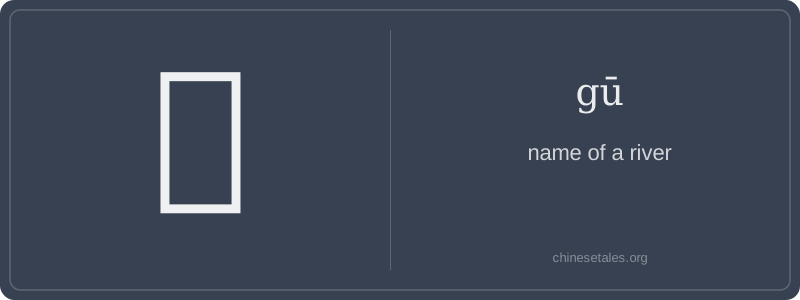
The earliest attested form of 泒 appears in Han dynasty bronze inscriptions and later Shuowen Jiezi (121 CE) as a phono-semantic compound: left side 氵 (water radical), right side 瓜 (guā, ‘melon’), used purely for sound — not meaning. Though 瓜 might suggest fruit, there’s no botanical link. The oracle bone script doesn’t contain 泒; it emerged later as a specialized geographical marker, likely coined during the Warring States period to distinguish this tributary of the Ji River (in modern Hebei) from other streams. Its strokes stabilized early: three dots for water, then the nine-stroke 瓜 — no simplification, no variant forms.
Over time, 泒 became fossilized in classical geography texts like the Shui Jing Zhu (Commentary on the Waterways Classic, 6th c. CE), where it appears alongside now-vanished rivers like the Qing River and Yi River. Its visual calm — water + melon — belies its role as a hydrological anchor: scholars used it to triangulate ancient floodplains and migration routes. Even today, archaeologists reference 泒 when interpreting Zhou dynasty bronze inscriptions mentioning ‘the southern banks of the Gū’, revealing how a single character can hold centuries of buried topography.
At first glance, 泒 (gū) looks like a quiet, obscure character — and it is: it’s not in the HSK, rarely appears in modern texts, and exists almost exclusively as a proper noun for a specific ancient river. But its very obscurity reveals something beautiful about Chinese linguistic culture: the deep reverence for geographical memory. Unlike English, where forgotten rivers vanish from language, Chinese preserves them in characters — not as abstract names, but as living glyphs anchored in water (氵) and sound (瓜). This isn’t just naming; it’s cartographic calligraphy.
Grammatically, 泒 functions solely as a noun — always capitalized in effect, like ‘Nile’ or ‘Yangtze’. You’ll never see it with measure words, adjectives, or verbs attached. It appears only in historical geography contexts, classical poetry allusions, or scholarly footnotes. Learners sometimes misread it as guā (‘melon’) due to the 瓜 component, or confuse it with 沽 (gū, ‘to buy/sell’), but 泒 carries no commercial or edible meaning — only hydrological identity.
Culturally, 泒 embodies the ‘river-as-ancestor’ mindset: many ancient Chinese rivers were seen as progenitors of clans and dynasties. Mistaking 泒 for another gū-sound character risks erasing that lineage. Also, note its radical is 氵 (three-dot water), not 水 — a subtle but critical distinction signaling it belongs to the semantic category of flowing bodies, not static water. Its rarity means even native speakers may pause — making it a quiet test of textual literacy and historical sensitivity.