泑
Character Story & Explanation
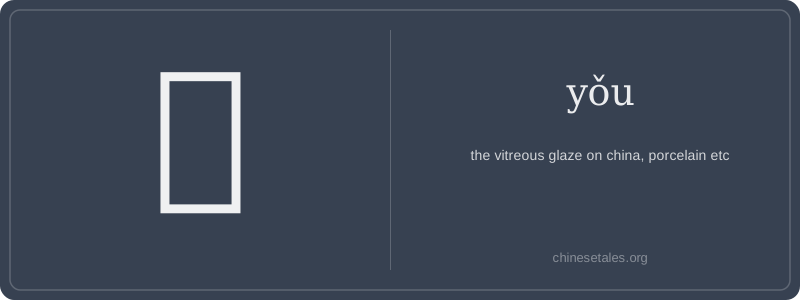
泑 is one of the most visually deceptive characters in Chinese: though it looks complex, its earliest form—found in Han dynasty bronze inscriptions—is remarkably minimal. The original graph combined 氵 (water radical, suggesting fluidity and shine) with 有 (yǒu, ‘to have’)—not as a phonetic component, but as a semantic hint: ‘that which gives the vessel its possessing, defining surface.’ Over centuries, the right-hand 有 gradually stylized, losing its ‘hand holding meat’ oracle bone clarity, becoming the simplified form we see today—yet the water radical remains vividly literal, evoking the liquid slip poured before firing and the glossy, water-like reflection after.
By the Tang and Song dynasties, 泑 appeared in kiln records and poetic descriptions of Ru ware, where critics praised ‘泑如凝脂’ (glaze like congealed fat)—referring to its dense, soft luminosity. Unlike generic terms like ‘glaze’ (釉, yòu), 泑 specifically denotes the *vitreous* quality: the glass-phase result of silica melting above 1200°C. Classical texts never use it for paint or lacquer—only fired ceramic surfaces. Its narrow, elevated usage preserved its precision: 泑 isn’t what you *apply*; it’s what emerges *after fire transforms intention into permanence.*
Imagine you’re in a Jingdezhen kiln workshop, where master potters lift freshly fired celadon bowls under the morning light—each surface shimmering with a translucent, jade-like sheen. That luminous, glassy skin isn’t just gloss; it’s 泑 (yǒu), the precise term for the vitreous glaze fused onto porcelain during high-temperature firing. It’s not decorative ‘paint’ or ‘coating’—it’s chemically bonded, molten silica cooled into a continuous, reflective layer. In Chinese, 泑 functions almost exclusively as a noun and appears almost solely in technical, historical, or artistic contexts—not daily speech.
Grammatically, 泑 rarely stands alone: you’ll see it in compounds like 泑色 (yǒu sè, 'glaze color') or 泑层 (yǒu céng, 'glaze layer'). You won’t say *‘this cup is 泑’*—that’s ungrammatical. Instead, you describe *the presence, quality, or type* of 泑: e.g., ‘这件青瓷的泑匀而润’ (This celadon’s glaze is even and lustrous). Learners often misread it as a verb or confuse it with similar-sounding words like ‘油’ (yóu, oil), leading to comical mistranslations like ‘the bowl is oiled’ instead of ‘has a vitrified glaze’.
Culturally, 泑 carries quiet prestige—it’s the invisible signature of mastery. A flawed 泑 (cracked, blistered, or uneven) can ruin centuries-old aesthetics; a perfect 泑 embodies the Daoist ideal of transformation through fire. Because it’s absent from HSK and modern textbooks, learners only encounter it when diving deep into ceramics, museum labels, or Song dynasty poetry describing ‘yǒu light trembling on a rain-pool surface.’ Its rarity makes it a linguistic fingerprint of connoisseurship—not vocabulary, but cultural literacy.