沷
Character Story & Explanation
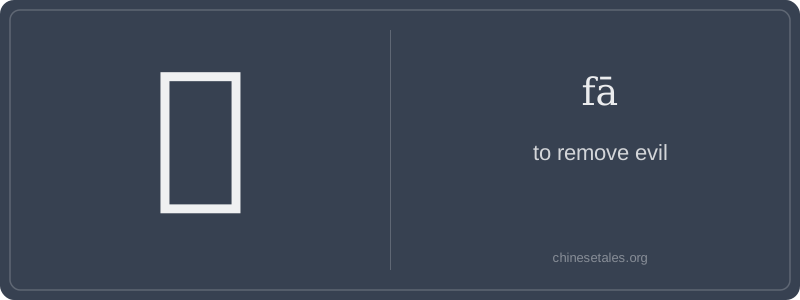
The earliest form of 沷 appears in Warring States bamboo texts (not oracle bones — it’s too late for that), where it was written with 氵 (water radical) on the left and 發 (fā, ‘to emit, send forth’) on the right — but crucially, the right-hand component was originally written with 弓 (bow) + 射 (to shoot) + 殳 (a ceremonial mace), suggesting a forceful, projectile expulsion. Over time, 弓 and 射 simplified into 癶 (bō, ‘to step forward’) and 癶 evolved into 發, then further stylized into the modern 發-like shape seen today — though the original meaning of ‘shooting evil away like an arrow’ remained embedded in its structure.
This visual logic shaped its semantic development: by the Han dynasty, 沷 appears in medical texts like the Huangdi Neijing describing how acupuncture ‘fā xié’ — not merely draining fluid, but *propelling* pathogenic influences outward through meridians. In Tang poetry, poets used 沷 metaphorically: Li Bai wrote of ‘fā chén’ (removing dust) from one’s spirit — equating mental clarity with ritual cleansing. The water radical (氵) isn’t about liquid, but about flow and purification — like water carrying away contamination. So 沷 isn’t static removal; it’s dynamic, directional ejection — a linguistic exorcism in one character.
Think of 沷 (fā) not as a verb you’ll use in daily conversation — it’s more like Latin ‘exorcizare’ or Old English ‘āwrecan’: a solemn, ritualistic word for driving out evil spirits or moral corruption. In classical Chinese, it carried the weight of Confucian self-cultivation and Daoist purification rites — less ‘delete spam email’ and more ‘ritually purge hubris from the heart’. Its core feeling is deliberate, ceremonial removal: not just eliminating something bad, but restoring cosmic or ethical balance.
Grammatically, 沷 is almost always transitive and appears in formal or literary contexts — rarely as a standalone verb in speech. You’ll find it in compound verbs like 沷邪 (fā xié, 'expel evil') or in passive constructions with 被 or 為: e.g., ‘邪氣被 沷 出體外’ (evil qi was expelled from the body). Learners mistakenly try to use it like 排 (pái, ‘to remove’) or 清除 (qīngchú, ‘to eliminate’) — but 沷 implies spiritual agency, not mechanical action. It doesn’t take objects like ‘the trash’ or ‘the file’; its object is always abstract and morally charged: 邪 (evil), 妖 (demons), 災 (calamity), or 心魔 (heart-demons).
Culturally, 沷 reflects ancient Chinese cosmology where illness, misfortune, and moral failure were often traced to invasive malignant forces. Mistaking it for a synonym of ‘remove’ leads to jarring translations — imagine saying ‘I 沷 my coffee cup’! Also, beware: it’s pronounced fā, not fà or fǎ — that first tone is non-negotiable, echoing the sharp, decisive exhale of a shaman’s chant.