沴
Character Story & Explanation
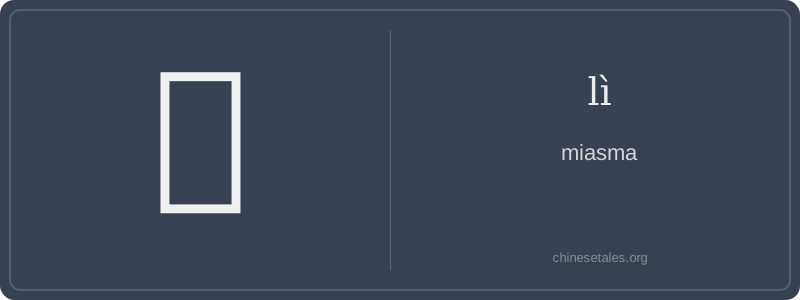
The earliest form of 沴 appears in Warring States bamboo texts — not oracle bones, but elegant ink inscriptions where the left side was 氵 (water radical), and the right was a stylized variant of 厉 (lì), meaning 'severe' or 'fierce', originally depicting a person with a weapon and an aggressive stance. Over centuries, the right-hand component simplified: the 'weapon' strokes fused into 刂 (knife radical), while the upper part condensed into 万 (wàn) — though this is purely graphical evolution, not semantic. By the Han dynasty clerical script, the character stabilized into today’s form: 氵+厉 → 沴, with the knife radical anchoring its sense of sharp, harmful force.
This visual fusion tells the story: *water gone fierce*. In the Hanshu (Book of Han), 沴 first appears in astrological records describing 'water miasma' (水沴) when rivers flooded unpredictably — seen not as natural disaster, but as Heaven’s rebuke. The Shuowen Jiezi (2nd c. CE) defines it as 'unharmonious qi between heaven and earth'. Later, in Tang poetry, it evokes eerie stillness before calamity — e.g., '山沴无光' (mountains shrouded in miasmic gloom). Its shape literally warns: when water loses its flow and gains a knife’s edge, imbalance has set in.
Think of 沴 (lì) as Chinese mythology’s version of 'bad vibes' — but way more serious than your friend’s off-day energy. It doesn’t mean generic pollution or smog; it’s a classical, almost supernatural term for *miasma*: noxious, yin-heavy vapors believed to rise from disrupted natural order — stagnant water, decaying earth, or cosmic imbalance. In ancient cosmology, 沴 described the foul qi that caused epidemics, droughts, or even dynastic collapse. You won’t hear it in daily conversation — it’s strictly literary or historical, like saying 'the ether was corrupted' in Victorian medical writing.
Grammatically, 沴 is almost always a noun and appears in compound nouns (e.g., 水沴, 地沴) or poetic phrases. It rarely stands alone, and never functions as a verb or adjective — a common learner mistake is trying to say 'this place is 沴' (❌). Instead, you’ll see structures like '出现水沴' (water miasma appeared) or '沴气弥漫' (noxious miasma permeated). Its usage is tightly bound to classical syntax: subject + 沴 + descriptive verb or modifier.
Culturally, 沴 reflects China’s deep-rooted correlative cosmology — where weather, health, and politics were all governed by the same invisible forces. Confusing it with modern environmental terms (like 污染 wūrǎn) misses its metaphysical weight. Learners often misread it as lǐ (like 里) or assume it’s related to 气 (qì), but 沴 isn’t about breath or air — it’s about *dissonant resonance*, the kind that makes heaven and earth groan.