沍
Character Story & Explanation
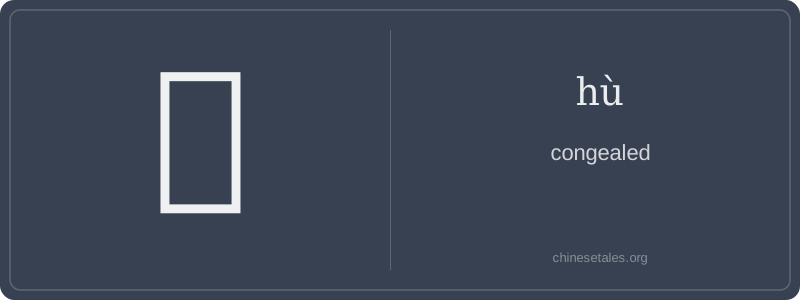
The earliest form of 沂 appears on Warring States bamboo slips as a water radical (氵) paired with a simplified glyph resembling two stacked 'mouths' (口口) or possibly a stylized depiction of layered ice crystals — not a literal picture, but an abstract visual echo of water *settling into strata*. Over centuries, the right-hand component evolved from 古 (gǔ, 'ancient') — suggesting time’s role in congealing — into 户 (hù), which phonetically anchors the pronunciation but visually misleads: this isn’t about 'doors,' but about the *threshold state* between liquid and solid. By the Han dynasty, the character stabilized into its current form: three dots of water + 户 — a quiet paradox: flowing water meeting something fixed and enclosed.
This visual tension mirrors its semantic journey. In the Classic of Mountains and Seas, 沂 described rivers whose currents grew sluggish near mountain roots — not frozen, but 'heavy with cold.' Later, in Sun Simiao’s Essential Prescriptions Worth a Thousand Gold, 沂 appeared in diagnoses like 'blood 沂 in the meridians,' meaning pathological thickening, not clotting. The character never meant 'ice' outright; instead, it captured the *viscous hesitation* before solidity — a nuance preserved only in literary and technical registers, where precision trumps simplicity.
Think of 沂 (hù) not as a frozen pond, but as the moment just before ice cracks — that tense, silent pause when water surrenders to cold and begins to hold itself still. In Chinese, 沂 doesn’t mean 'ice' or 'frost'; it’s the *process* of congealing — the transformation from fluid to firm, often used poetically or medically to describe bodily fluids thickening (like blood stagnating) or sap hardening in winter wood. It’s deeply tactile: you don’t *see* 沂 — you *feel* its resistance, like honey chilling in a jar.
Grammatically, 沂 is almost never used alone. It appears exclusively in classical compounds or literary set phrases — never in modern spoken Mandarin, and never as a verb stem or adjective by itself. You’ll find it in four-character idioms (e.g., 沂而不流), or in poetic descriptions where precision matters more than frequency: 'the river’s flow 沂 at dawn' implies not stopping, but *thickening*, slowing, becoming viscous with cold mist. Learners mistakenly try to substitute it for 冻 (dòng, 'to freeze') — but 沂 is subtler, slower, and carries no temperature marker; it’s about consistency, not degree.
Culturally, 沂 lives in the margins — in Tang dynasty poetry, Ming medical texts, and Daoist alchemical manuscripts describing 'qi congealing into essence.' Its rarity makes it a telltale sign of advanced reading: spotting 沂 is like finding a watermark in handmade paper. A common error? Assuming it’s related to 湖 (hú, 'lake') because of the water radical — but while 湖 is expansive and open, 沂 is inward, contracting, almost secretive.