沆
Character Story & Explanation
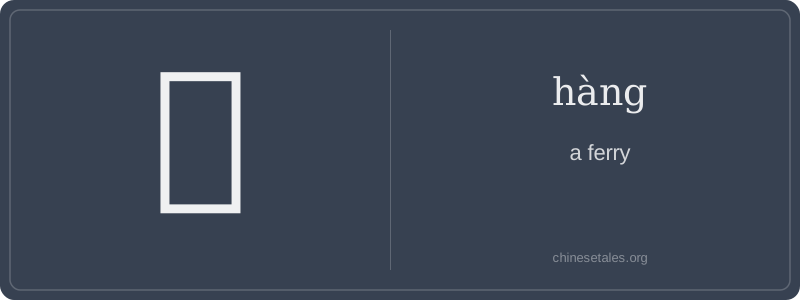
The earliest form of 沆 appears in Warring States bamboo slips as a flowing, three-stroke water radical (氵) paired with a simplified version of 亢 (kàng) — originally a pictograph of a person standing tall with raised arms, later stylized to mean 'high' or 'rising'. Over centuries, 亢 lost its human posture and became an abstract phonetic component, while the water radical anchored the meaning firmly to aquatic transit. By the Han dynasty, the character stabilized into its current seven-stroke form: three dots for water, then the compact 亢 (4 strokes: 亠 + 几 + 丶).
In the Chu Ci (Songs of Chu), 沆 appears in lines like '沆瀣一气' — wait! No, that’s a famous *misattribution*: the phrase is actually 沆瀣 (hàng xiè), meaning 'dew and mist', where 沆 refers to *dawn mist rising from water* — revealing its deeper semantic root: not just 'ferry', but the *ethereal, transitional vapor above still water*, which metaphorically extended to 'crossing' — a subtle, silent passage. So 沆 isn’t about the boat; it’s about the liminal hush *between* shores.
Let’s cut through the fog: 沆 (hàng) is not a common word in modern spoken Chinese — it’s a literary, almost poetic relic meaning 'a ferry' or 'ferrying across water', especially in classical contexts. Don’t confuse it with the far more common 渡 (dù) or 搭船 (dā chuán); 沆 carries an archaic, rhythmic weight — think of a lone boat gliding across misty river waters at dawn, not your daily commute on the Yangtze cruise ship.
Grammatically, 沆 appears almost exclusively as a noun (e.g., 沆舟 — 'a ferry boat') or in compound verbs like 沆渡 (hàng dù), where it intensifies the sense of crossing a wide, tranquil, perhaps spiritually significant expanse. You’ll rarely see it alone in a sentence — it thrives in four-character idioms or parallel constructions in poetry and historical prose. Learners often mistakenly treat it as a verb ('to ferry'), but it’s never used that way without a supporting verb like 渡 or 行.
Culturally, 沆 evokes classical Daoist and Chu Ci imagery — rivers as thresholds between worlds, and ferries as quiet mediators of transition. It’s easy to misread its radical 氵 (water) as implying 'ocean' or 'vast water', but here it signals *movement across water*, not depth or volume. And crucially: despite sounding like 'hang' (as in suspend), it has zero connection to hanging, lifting, or waiting — a classic sound-alike trap for beginners.