汕
Character Story & Explanation
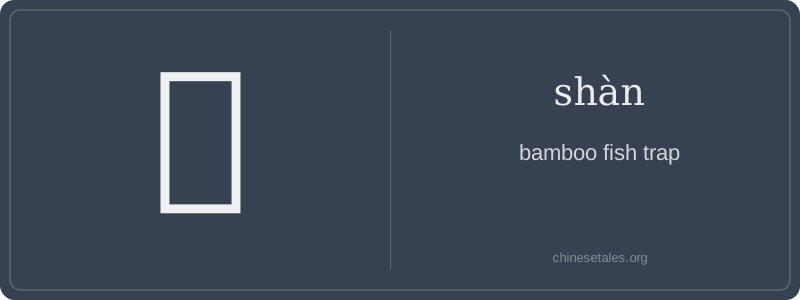
The earliest form of 汕 appears in bronze inscriptions as a combination of 水 (water, later simplified to 氵) and 山 (mountain-like ridges), but here, 山 isn’t geographical — it’s a stylized depiction of interwoven bamboo strips forming a tapered, mountain-shaped trap. Over centuries, the water radical stabilized on the left (氵), while the right side condensed from 山 into the modern, streamlined shape — six strokes total: three dots (氵), then three strokes mimicking layered, converging bamboo slats (彡-like flow). It’s a rare case where the ‘mountain’ component became abstracted into texture, not terrain.
This character first appeared in the *Shuōwén Jiězì* (c. 100 CE) as ‘a fish-catching device placed in running water’, emphasizing directionality and current. By the Tang dynasty, it was already archaic in daily speech but persisted in regional toponyms — especially along Guangdong’s rivers, where such traps were still used. The visual logic holds: 氵 signals water dependency; the right side’s rhythmic, descending strokes evoke both bamboo weaving *and* the narrowing throat of the trap — a perfect fusion of function, material, and flow.
Imagine a misty dawn on the Pearl River Delta: an elderly fisherman in a conical hat lowers a woven bamboo cage into slow-moving water — not with hooks or nets, but with quiet confidence. That cage? In classical texts, it’s called a shàn: a clever, funnel-shaped trap that lets fish swim in but blocks their exit. This is the heart of 汕 — not just ‘a fish trap’, but a specific, ancient, water-based technology rooted in harmony with currents and tides.
Grammatically, 汕 is almost never used alone in modern Mandarin. It appears only in proper nouns (like Shantou city) or classical compounds — think of it as a ‘fossil word’ preserved in place names and poetry. You won’t say *‘I set a shàn today’*; instead, you’ll see it in historical texts like *Shuōwén Jiězì*, where it’s defined as ‘a device for catching fish in flowing water’. Learners often mistakenly treat it as a common noun or verb — but it’s neither. Its usage is tightly bound to hydrology, geography, and antiquity.
Culturally, 汕 carries the quiet weight of Southern China’s riverine ingenuity. Mistaking it for a generic ‘fish’ character (like 鱼) misses its specificity: this is about *flow*, *trapping by design*, not capture by force. Also, don’t confuse its pronunciation — it’s shàn (fourth tone), *not* shān or xiān — a subtle but critical distinction when reading place names like 汕头 (Shàntóu).