汔
Character Story & Explanation
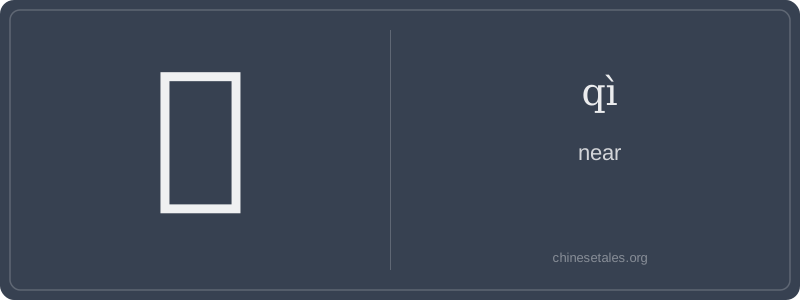
The earliest form of 汔 appears in Western Zhou bronze inscriptions as a simple yet elegant pictograph: three wavy lines (later standardized as 氵) representing flowing water, paired with the character 乞 (qǐ), which originally depicted a person with arms raised in supplication — symbolizing reaching toward something just out of grasp. Over centuries, 乞’s top stroke simplified and merged visually with the water radical, yielding the modern six-stroke form where the left side flows (氵) and the right side leans forward (乞 → 汔), as if the water itself is edging closer to shore.
This visual metaphor crystallized its meaning: 'nearness' not as static location, but as dynamic approach — like a river nearing its estuary. In the Classic of Poetry (Shījīng), 汔 appears in lines describing seasonal shifts ('autumn’s chill 汔 至'), reinforcing its temporal nuance. Unlike similar characters, 汔 never acquired extended meanings like 'beg' (乞) or 'energy' (氣); it stayed narrowly focused on imminence — a rare case of semantic discipline across three millennia.
At first glance, 汔 (qì) feels like a quiet ghost in modern Chinese — it’s rarely spoken aloud and almost never appears in daily conversation or HSK textbooks. Its core meaning is 'near' or 'approaching', but not in the spatial sense of 'close by'; rather, it conveys a subtle, almost poetic sense of imminence — something on the verge of happening, like dusk nearing, a decision nearing completion, or a boundary nearly crossed. Think of it as the linguistic equivalent of holding your breath before a leap.
Grammatically, 汔 functions almost exclusively as an adverbial particle in classical and literary Chinese, often preceding verbs to signal proximity in time or degree: 汔成 (qì chéng, 'nearly accomplished'), 汔至 (qì zhì, 'just about to arrive'). You’ll almost never see it standalone — it always leans on another word, like a whisper supporting a statement. Learners mistakenly try to use it like 立刻 or 快, but 汔 carries no urgency; it’s contemplative, measured, even solemn — more 'the moment before dawn' than 'right now'.
Culturally, 汔 thrives in philosophical and historical texts — you’ll find it in the Book of Documents (Shūjīng) describing dynastic transitions ('the mandate was 汔 终') or in Tang poetry evoking twilight's hush. A common mistake? Confusing it with 已 (yǐ, 'already') or 氣 (qì, 'vital energy') — both sound identical but shift meaning entirely. Remember: 汔 isn’t about what *has* happened or what *is*, but what *is about to be* — a grammatical sigh before the turning point.