汋
Character Story & Explanation
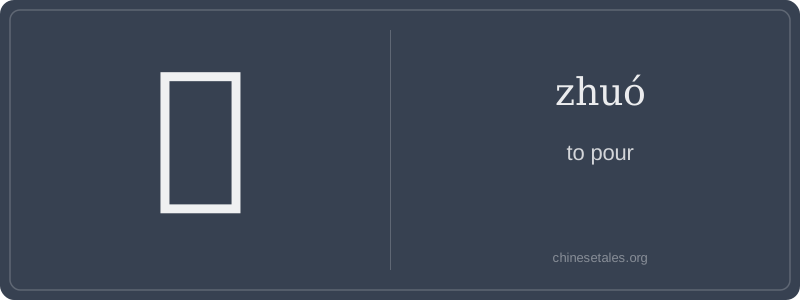
The earliest form of 汋 appears in bronze inscriptions (c. 1000 BCE) as a striking pictograph: three horizontal lines representing liquid (like the water radical 氵), above a stylized vessel — often drawn as a wide-mouthed urn with a curved spout. Over centuries, the vessel simplified into the right-hand component — the ancient character 卓 (zhuó, 'lofty, outstanding'), which originally depicted a tall pole or stand. The water radical 氵 was added later for semantic clarity, making 汋 a phono-semantic compound: 氵 (water) + 卓 (sound clue zhuó).
This evolution mirrors its meaning shift: from a literal depiction of liquid flowing from a raised vessel, it became associated with elevated, ceremonial acts — pouring wine high (卓) as an offering to heaven or ancestors. In the Book of Rites (Lǐjì), 汋 appears in passages describing ancestral sacrifices: '汋酒三巡' (zhuó jiǔ sān xún) — 'libate wine three times', each pour rising symbolically toward the spirits. The character’s visual height — both in stroke structure (tall 卓) and cultural function — remains inseparable from its meaning.
At first glance, 汋 (zhuó) feels like a quiet, almost forgotten verb — it means 'to pour', but not the everyday kind you’d use for tea or water. It’s poetic, ritualistic, and deeply tied to reverence: think pouring wine as an offering to ancestors, or libating wine onto the earth in classical ceremony. Unlike the neutral 倒 (dào) — which you’d use to 'pour out leftovers' — 汋 carries weight, intention, and solemnity. You’ll rarely hear it in modern spoken Mandarin; it lives in classical texts, opera lyrics, and formal ritual language.
Grammatically, 汋 is transitive and often appears in literary or compound verbs like 汋酒 (zhuó jiǔ, 'to libate wine') or 汋祭 (zhuó jì, 'to perform a libation sacrifice'). It doesn’t take aspect particles easily (no 汋了 or 汋过 in natural usage), and learners who force it into colloquial sentences — like *我汋了一杯水* — sound jarringly archaic or even nonsensical. Native speakers would instinctively switch to 倒 or 注 (zhù, 'to infuse/pour in').
Culturally, 汋 reveals how Chinese language encodes intentionality into action: the act of pouring isn’t just physical transfer — it’s a bridge between human and spirit, living and departed. That’s why it’s absent from HSK — it’s not about utility, but about cosmology. Learners’ biggest mistake? Assuming all 'pouring' verbs are interchangeable. In fact, confusing 汋 with 倒 is like using 'beseech' instead of 'ask' — technically correct, but socially dissonant.