汊
Character Story & Explanation
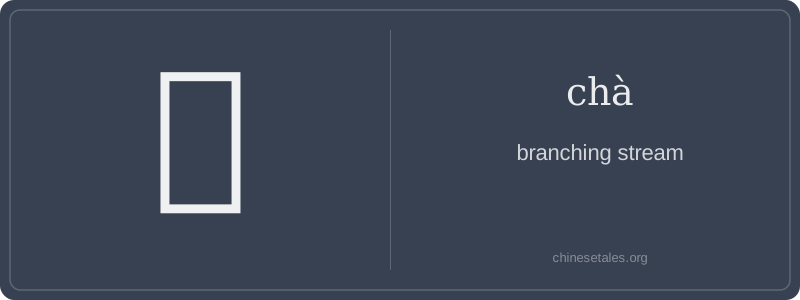
The earliest form of 汊 appears in seal script (c. 3rd century BCE) as three flowing water lines (氵) on the left — a clear radical for 'water' — fused with 叉 (chā) on the right, which originally depicted a two-pronged tool or fork. In oracle bone inscriptions, there’s no direct precursor, but by the Warring States period, scribes combined 氵 + 叉 to create a new character: the water (氵) being actively 'forked' (叉). The six strokes solidified early — three for the water radical (not four!), two for the upper arms of 叉, and one for its base — preserving the idea of splitting flow without clutter.
This character didn’t appear in the earliest classics like the Shijing, but gained traction during the Tang and Song dynasties in hydraulic texts and local gazetteers describing the intricate river networks of the Jiangnan region. Its visual logic is elegant: the left side ‘is’ water; the right side ‘does’ the splitting. Interestingly, 叉 itself evolved from a pictograph of a hunting fork — so 汊 subtly carries ancient human intervention in nature: not just water parting, but water *guided*, *managed*, even *harnessed*. That quiet intentionality — water shaped by both geography and will — echoes in every modern use.
Think of 汊 (chà) as the Chinese word for a 'stream fork' — not just any branch, but specifically where a river splits into two or more distinct, navigable channels. It’s deeply geographical and visual: you can almost see the water dividing. Unlike generic words like 分 (fēn, 'to divide'), 汊 carries hydrological precision — it’s used in maps, local place names, and engineering reports to denote a deliberate, natural bifurcation point. You’ll rarely hear it in daily conversation, but if you’re reading a Yangtze River hydrology paper or hiking near Wuhan’s Han River tributaries, this character appears with quiet authority.
Grammatically, 汊 functions mainly as a noun (e.g., 汊口 chàkǒu, 'fork mouth' = confluence), sometimes as a verb meaning 'to branch off' — though this usage is literary and rare. Learners often misread it as chā (like 差) or confuse it with 叉 (chā), but note: 汊 is *always* chà, and *only* refers to water branching — never roads, ideas, or data structures. Also, it’s almost never used alone; it nearly always appears in compounds like 汊道 or 汊流.
Culturally, 汊 reflects how intimately Chinese civilization mapped and named its waterways — every bend, split, and inlet earned a precise term. Mistaking 汊 for 叉 or 茶 (chá) is common: the former looks similar but means 'fork' broadly (and is chā), while the latter is 'tea' and shares only the right-hand component. Native speakers instantly sense the watery weight of 汊 — it’s not abstract division; it’s liquid geometry etched into the land.