汀
Character Story & Explanation
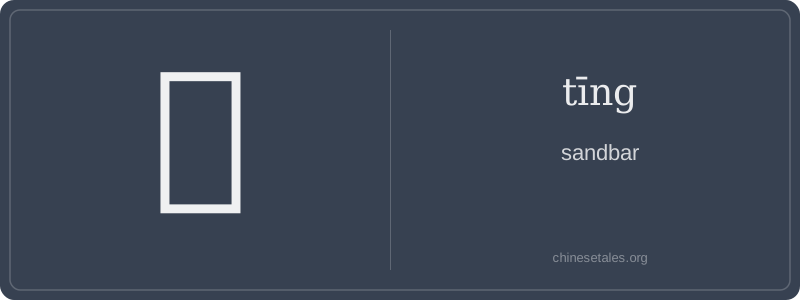
The earliest form of 汀 appears in seal script (not oracle bone — too small a feature for early inscriptions), showing three water drops (氵) on the left and ‘丁’ (dīng) on the right: a pictographic fusion. The left side, 氵, clearly signals water-related meaning. The right side, 丁, wasn’t chosen for its sound alone — though it does provide the pronunciation tīng — but because its shape resembles a *nail* or *post*, evoking something *anchored* or *projecting* into water: think of a wooden stake marking shallow land. Over time, the water radical standardized into three dots, and 丁 simplified from a full square-with-cross to its clean, angular modern form — five strokes total: three for water, two for 丁.
This visual logic held firm across dynasties: 汀 always meant ‘a small piece of dry land rising within water’. In the *Shuōwén Jiězì* (121 CE), Xu Shen defined it as ‘a flat place at water’s edge’, emphasizing levelness and accessibility. Tang dynasty poets used it to contrast transience and tranquility — a sandbar appears and vanishes with the tide, yet feels eternal in verse. Its persistence isn’t due to utility, but to aesthetic necessity: Chinese landscape writing demands precise, evocative terms for micro-geographies, and 汀 fills that niche with unmatched grace — a single character holding both hydrology and haiku.
Picture a quiet, sunlit stretch of riverbank where water gently laps against a narrow strip of sand and pebbles — that’s the world of 汀 (tīng). It doesn’t mean ‘beach’ or ‘shore’ broadly; it’s specifically a *sandbar*: a slender, often temporary landform emerging just above the waterline, shaped by currents and tides. In classical Chinese, 汀 evokes stillness, intimacy with water, and subtle boundary — neither fully land nor fully water. You’ll almost never hear it in daily speech (hence its absence from HSK), but it thrives in poetry, place names, and literary description, carrying a soft, lyrical weight.
Grammatically, 汀 functions as a noun — usually unmodified and rarely pluralized (no ‘-s’ equivalent). It appears in compound nouns like 沙汀 (shā tīng, ‘sandbar’) or 水汀 (shuǐ tīng, ‘water’s edge’), but almost never alone as a subject or object in modern spoken sentences. Learners sometimes misread it as a verb (‘to settle’?) because of its calm visual rhythm — but no: it’s purely nominal, and never used as a measure word or classifier. Also, don’t confuse it with 汀步 (tīng bù) — those stepping stones across streams? That’s a different word entirely, though the first character is the same!
Culturally, 汀 is a ‘quiet classic’ — beloved by poets from Du Fu to contemporary lyricists for its visual precision and gentle ambiguity. It appears in famous lines like ‘芳草萋萋鹦鹉洲’ (fragrant grasses thick on Parrot Isle’s *tīng*), where 洲 (zhōu) is a larger island, but 汀 is the delicate fringe. Mistake it for 汀 (tīng) vs. 丁 (dīng)? Big difference: one is watery poetry, the other is a census unit or the ‘Ding’ surname. And yes — even native speakers occasionally pause before writing it, because its five-stroke simplicity hides an elegant, ancient logic.