氿
Character Story & Explanation
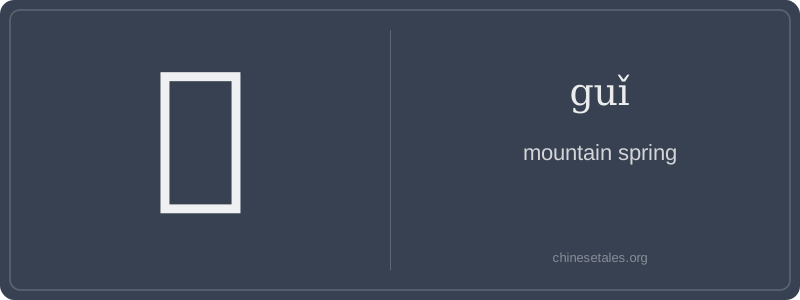
The earliest form of 氿 appears in bronze inscriptions (c. 1000 BCE) as a stylized pictograph: three wavy lines (representing water, later standardized as the 氵 radical) flowing downward beside a simplified mountain shape (山). Over centuries, the mountain component evolved — its peaks sharpened into angular strokes, then condensed into the top-right 乚 (a hook stroke), while the water element settled into the familiar left-side three-dot radical. By the Han dynasty clerical script, the five-stroke structure was fixed: 氵 + 乚 — elegant, minimal, and deliberately evocative of water *issuing* from stone.
This visual economy reflects its meaning: not just any spring, but one born *of the mountain itself* — unfiltered, unchanneled, spontaneous. In the Shijing (Book of Odes), 氿 appears in odes praising ancestral lands where ‘the 氿 flows clear beside the ancestral temple’ — linking hydrology with lineage and virtue. Later, Tang poets like Wang Wei used 氿 to contrast artificial gardens with untamed nature: the character became shorthand for authenticity, untouched origin, and quiet resilience — all packed into five strokes.
At its heart, 氿 (guǐ) isn’t just ‘mountain spring’ — it’s a poetic compression of nature’s quiet vitality: the moment water first emerges from rock, clear, cool, and unpolluted. In classical Chinese, it evokes purity, origin, and gentle persistence — think of a single drop forming in a limestone cave before becoming a stream. Modern usage is highly literary or regional; you won’t hear it in daily chat or see it on subway signs. It appears mostly in poetry, place names (like ancient village springs), or formal descriptions of landscapes — never as a verb or standalone noun in speech.
Grammatically, 氿 functions almost exclusively as a noun, often modified by adjectives like 清澈 (qīng chè, clear) or 山间 (shān jiān, mountain-located), and rarely takes measure words. Learners sometimes mistakenly use it like 泉 (quán), but that’s a broad, neutral term for ‘spring’ or ‘fountain’ — while 氿 carries an almost sacred specificity: it must be *mountain-born*, *unmixed*, and *emergent*. You wouldn’t say ‘my backyard 氿’ — it implies wildness, antiquity, and reverence.
A common pitfall? Confusing it with homophones like 轨 (guǐ, ‘track/rail’) or 圭 (guī, ‘jade tablet’) — same sound, wildly different worlds. Also, because it’s absent from HSK and most textbooks, learners often miss its subtle cultural weight: in Daoist and early poetic thought, 氿 symbolizes the undifferentiated source — the ‘water before the river’, echoing the Dao De Jing’s ‘the highest good is like water.’