氜
Character Story & Explanation
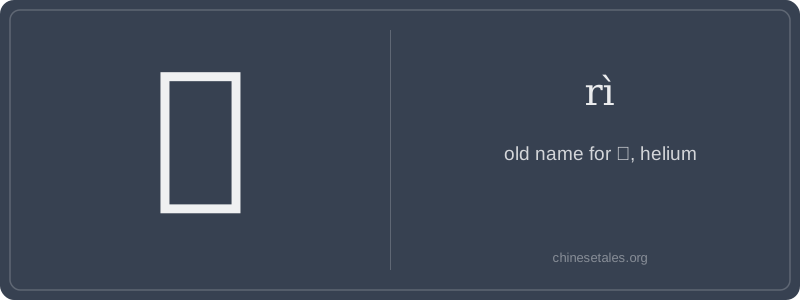
The character 氜 first appeared in the early 20th century — not in oracle bones or bronze inscriptions (it’s too new for that!), but as a deliberate scholarly coinage. Its structure is transparent: top is 日 (rì, ‘sun’), bottom is 气 (qì, ‘gas’ or ‘vapor’). Visually, it’s a stacked compound — not a pictograph but a semantic-phonetic hybrid where 日 hints at origin (helium was first detected in sunlight during the 1868 solar eclipse) and 气 signals category. Stroke order begins with 日’s four strokes (vertical, horizontal-fold, horizontal, closing horizontal), then moves to 气’s four: the three horizontal lines plus the final rising dot-stroke — totaling eight clean, balanced strokes.
Its meaning emerged directly from scientific necessity: Western chemists named helium ‘helium’ from Greek ‘helios’ (sun), and Chinese translators mirrored that logic with 日 + 气. Though never common in classical literature — it simply didn’t exist before 1900 — it appeared in early editions of the 《化学鉴原》 (‘Chemical Origins’, 1871 translation) and later in the 1932 ‘Chemical Nomenclature Draft’ by the National Academy of Sciences. By the 1950s, standardization favored 氦 (hài), whose phonetic component 海 (hǎi) better approximated ‘helium’’s sound — sealing 氜’s fate as a graceful footnote in linguistic history.
Think of 氜 (rì) as Chinese chemistry’s vintage vinyl record — a beautifully obsolete label. It’s the old, pre-1950s name for helium, used when Chinese scientists were translating Western chemical terms and chose characters that reflected elemental properties or classical resonance. Unlike modern 氦 (hài), which was standardized after the 1950s to align with international nomenclature, 氜 carries a quiet, almost poetic weight: its ‘gas’ radical (气) paired with 日 (sun) evokes helium’s discovery in the sun’s spectrum — literally ‘sun gas’. It feels like finding a Latin botanical name still whispered by botanists who love tradition.
Grammatically, 氜 is strictly a noun — never a verb, adjective, or measure word — and appears only in historical scientific texts, museum labels, or stylistic references to early 20th-century science. You’ll never hear it in daily speech or modern textbooks. Example: ‘科学家在1908年分离出氜’ — note how it functions identically to 氦 but signals temporal precision. Learners sometimes misread it as 日 (rì, ‘sun’) due to identical pronunciation and visual overlap — a harmless slip in reading, but a conceptual one: confusing the *source* (sun) with the *substance* (helium gas).
Culturally, 氜 is a linguistic fossil — preserved not because it’s useful, but because it honors a moment when China’s scientific community was actively reimagining language itself. Mistake alert: don’t try to use it conversationally. Saying ‘我需要氜’ will puzzle native speakers; they’ll assume you’re quoting an antique textbook or joking about steampunk chemistry. Its charm lies entirely in its rarity — like using ‘aether’ instead of ‘medium’ in English physics talk.