氚
Character Story & Explanation
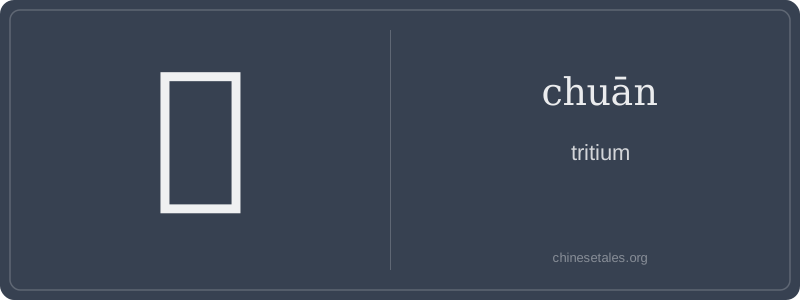
The character 氚 didn’t exist before the 1930s — no oracle bones, no bronze inscriptions, no Shuōwén Jiězì entry. It was invented in the early Republic of China era as part of a systematic effort to translate Western chemical nomenclature. Its form merges two pre-existing elements: the top-left radical 气 (qì), simplified from 氣, representing gaseous substances, and the right-hand component 川 (chuān), a pictograph originally depicting three parallel flowing streams — later abstracted into three horizontal strokes with vertical connectors. When fused, the seven-stroke structure emerged: 气 (4 strokes) + 川 (3 strokes), visually suggesting 'a gas that flows like a river' — though that’s poetic license, not etymology.
Historically, 氚 carries zero classical baggage. You won’t find it in the Analects, the Dao De Jing, or Tang poetry — it entered Mandarin through Japanese scientific terminology (tritium → トリチウム → 氚) in the 1930s, then spread across Sinosphere academic circles. Its visual simplicity belies its conceptual weight: that single 川 isn’t about water, but about atomic mass — the 'third' hydrogen isotope (hence 川 ≈ 'three' via homophone: 三 sān vs. 川 chuān — not identical, but part of a broader pattern where sound approximations guided naming). Its design is pure 20th-century pragmatism: recognizable, pronounceable, and classifiable under 气 — a quiet triumph of linguistic infrastructure.
At first glance, 氚 (chuān) looks like a humble character — just seven strokes, tucked under the 'vapor' or 'gas' radical 气. But don’t be fooled: this is a 20th-century scientific import, born not from ancient philosophy but from nuclear physics labs. In Chinese, it doesn’t evoke poetry or breath like other 气 characters (e.g., 氣/气 for 'qi' energy); instead, it’s strictly technical — the name for hydrogen-3, the radioactive isotope used in fusion research and luminous watch dials. Native speakers treat it like a loanword: precise, unemotional, and almost exclusively found in textbooks, safety manuals, or news reports about nuclear facilities.
Grammatically, 氚 behaves like a noun — no verb forms, no adjectival use. It never stands alone in speech; you’ll always see it in compounds like 氚灯 (chuān dēng, tritium lamp) or 氚化水 (chuān huà shuǐ, tritiated water). Learners sometimes mistakenly try to use it as a verb ('to tritiate') or pluralize it — but Chinese doesn’t do that. It’s monolithic: one syllable, one meaning, one context. And yes — it’s tone 1, not tone 2; mispronouncing it as chuán sounds like 'boat' and triggers polite confusion.
Culturally, 氚 reveals how Chinese handles scientific modernity: by co-opting the classical radical system with deliberate logic. The choice of 气 signals 'gaseous element', while the right-hand component 川 (chuān, 'river') was borrowed purely for its sound — a classic phono-semantic compound. This isn’t poetic resonance; it’s engineering elegance. A common learner trap? Assuming 氚 relates to weather or steam because of 气 — but no, this 'vapor' is invisible, unstable, and measured in becquerels, not breaths.