氙
Character Story & Explanation
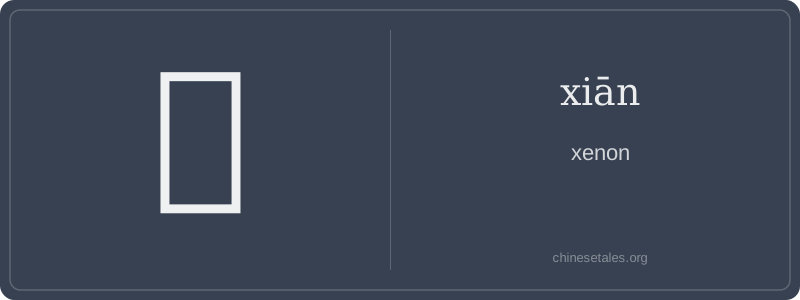
The character 氙 didn’t exist in oracle bone or bronze inscriptions — it’s a deliberate 20th-century coinage, born when Chinese scientists needed names for newly discovered elements. Its form merges the ‘gas’ radical 气 (top, 4 strokes: 丿、一、丿、㇏) with the phonetic component 廌 (zhì, originally a mythic one-horned beast symbolizing justice, simplified here to 厂 + 乚 + 一 + 丨 + 一). In modern writing, the lower part condensed into the elegant, streamlined 厂 + 乚 + 一 — just 3 strokes beneath 气, totaling exactly 7 strokes. Visually, it looks like ‘gas rising from a judge’s gavel’ — absurd, yes, but perfectly logical for its time: 气 signals state (gaseous), 廌 supplies the xiān sound.
Historically, 氙 carries zero classical baggage — no mentions in the Shuōwén Jiězì, no poetic allusions in Tang verse. Its meaning didn’t evolve; it was assigned at birth: xenon, element 54. Yet its visual structure echoes ancient logic: just as 氧 (yǎng, oxygen) uses 羊 for sound and 气 for category, 氙 follows the same systematic pattern — making it a linguistic fossil of China’s scientific modernization. The ‘judge’ 廌 may be gone, but its ghost lingers in the curve of that final stroke — a silent nod to rigor, precision, and the quiet authority of the periodic table.
Imagine you’re in a high-tech lab in Shanghai, watching a scientist flick a switch — suddenly, a blinding blue-white flash erupts from a sealed glass tube. ‘That’s pure 氙 (xiān) gas ionizing,’ she says, adjusting her goggles. This isn’t some ancient herbal remedy or poetic metaphor — 氙 is a hyper-modern, ultra-rare noble gas, and its Chinese name reflects that precision: it’s not used in daily speech, poetry, or idioms — it lives exclusively in chemistry labs, lighting engineering specs, and medical imaging manuals.
Grammatically, 氙 behaves like any elemental noun in Chinese: it’s uncountable, never pluralized, and almost always appears with classifiers like 种 (zhǒng, ‘type’) or in compound terms like 氙灯 (xiān dēng, xenon lamp). You’ll never say *‘two 氙’* — instead, it’s ‘0.087 ppm of 氙 in Earth’s atmosphere’ or ‘the 氙 laser system malfunctioned.’ It rarely stands alone; context is everything. Learners sometimes mistakenly treat it like a verb or try to add aspect particles (了, 过), but no — 氙 is a rock-solid, immutable noun, as inert chemically as it is syntactically.
Culturally, 氙 is a quiet testament to how Chinese absorbs scientific concepts: the character was coined in the early 20th century using the ‘gas’ radical 气 + 廌 (a mythical unicorn-judge, repurposed here purely for sound). Its tone (xiān, first tone) mimics the English ‘zen-on’, subtly bending Western science into Mandarin phonology — not through translation, but transcription with scholarly flair. Mistake it for 氣 (qì, ‘vital energy’) and you’ll accidentally turn your physics report into Taoist cosmology!