毳
Character Story & Explanation
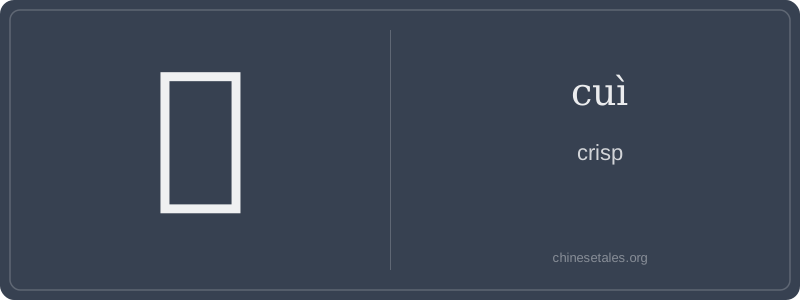
The earliest form of 毳 appears on Warring States bamboo slips as three stacked 毛 (‘hair’) radicals — not two, not four, but precisely three — each drawn with a curving shaft and feathery tip, arranged vertically like tufts of down layered for warmth. Over centuries, scribes streamlined the top two 毛 into simplified, mirror-image hooks, while preserving the full third 毛 at the bottom — hence the modern 12-stroke structure: three ‘hair’ units sharing a single vertical line as backbone. This triple-hair motif wasn’t decorative; it was taxonomic precision — distinguishing fine underfur from coarse guard hairs or feathers.
By the Han dynasty, 毳 had crystallized as the go-to term for animal down so soft it defied classification as mere ‘hair’ or ‘feather’. The Shuōwén Jiězì (121 CE) defines it as ‘the fine hair of birds and beasts’, and the Classic of Mountains and Seas describes the ‘cui bird’ whose nest is lined with this ethereal fluff. Its visual logic is stunningly literal: three layers of hair = ultimate softness. No metaphor, no abstraction — just zoological observation carved into script. Even today, when you see 毳, you’re seeing ancient China’s microscopic gaze on nature’s finest insulation.
At first glance, 毳 looks like a fluffy cloud of hair — and that’s exactly the point. Its core meaning isn’t ‘crisp’ in the modern culinary or textural sense (like potato chips), but rather ‘fine, soft, downy hair’ — think duckling fluff or the delicate undercoat of a yak. This ancient zoological precision survives in classical texts and technical vocabulary, where 毳 always implies *microscopic softness*, not brittleness. Learners often misread it as ‘crisp’ because some dictionaries list that English gloss — but that’s a misleading shorthand; there’s no native Chinese speaker who’d say 毳饼干 (‘crisp cookie’) — it simply doesn’t collocate that way.
Grammatically, 毳 is almost never used alone. It’s a bound morpheme — you’ll find it only in compounds like 毳毛 (cuì máo, ‘downy hair’) or 毳皮 (cuì pí, ‘shearling’). It never functions as an adjective modifying nouns directly (e.g., ❌ 毳苹果), nor does it take aspect particles like 了 or 过. Think of it as a fossilized root: dignified, precise, and stubbornly un-flexible. Its tone is fourth (cuì), and its pronunciation rhymes with ‘sweat’ — a helpful auditory anchor if you imagine tiny beads of sweat clinging to fine fur.
Culturally, 毛 (the radical) gives away its kinship with all things hairy — from scalp hair (头发) to feathered wings (羽毛) — but 毳 zooms in further: it’s the *underlayer*, the insulating fuzz beneath the guard hairs. That subtlety explains why it appears in classical descriptions of rare animals (e.g., the mythical ‘cui beast’ in the Shan Hai Jing) and modern textile labels for luxury shearling. A common mistake? Confusing it with 翠 (jade-green) — same tone, similar sound, but zero semantic overlap. Remember: 毳 = *fur*, 翠 = *jade* — one’s tactile, the other’s visual.