毪
Character Story & Explanation
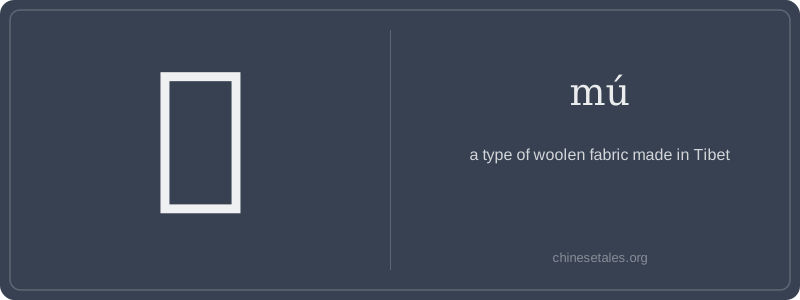
The character 毪 first appeared in late Han dynasty clerical script, not oracle bone — it’s a relatively young character, born from linguistic contact. Its left radical 毛 (máo, ‘hair/fur’) is instantly recognizable: three downward strokes mimicking coarse animal fibers. The right side, 無 (wú, ‘without’), is borrowed phonetically — not semantically — to approximate the Tibetan pronunciation. In early forms, the 無 component was simplified from its full 12-stroke version to just the core framework (the ‘dance’ radical 十 + four dots), eventually settling into today’s 4-dot + horizontal stroke shape. Stroke order reflects this duality: start with 毛’s three tuft-like strokes (丿 丿 乚), then build 無’s top (一), middle (), and final four dots (丶 丶 丶 丶).
Its meaning emerged not from Chinese textile tradition but from Tang-era diplomatic exchanges with Tubo (Tibet). Early records in the Tang Huiyao mention ‘mú bù’ (mú cloth) as tribute, described as ‘dense as felt, lustrous as silk, impervious to mountain rain’. By the Yuan dynasty, Mongol rulers adopted it for ceremonial robes, cementing its elite status. Visually, the character’s contrast — soft 毛 beside abstract 無 — mirrors its essence: raw natural material transformed by human absence of artifice (無), i.e., traditional handwork without machines. No classical poem uses 毪 alone — it always appears in compounds, underscoring its role as a cultural loanword, not a native semantic concept.
Think of 毪 (mú) as China’s answer to Harris tweed — but with yak hair, Himalayan altitude, and centuries of monastic craftsmanship. It doesn’t mean ‘wool’ in the generic sense; it names a *specific*, high-status Tibetan textile — dense, water-resistant, traditionally handwoven from goat or yak undercoat. Unlike English ‘wool’, which is a material category, 毪 is a proper noun turned common noun: it’s culturally anchored, like ‘Cashmere’ or ‘Gore-Tex’. You’ll almost never see it used adjectivally (e.g., *not* ‘a mú coat’) — it appears as a standalone noun or in compound terms like 毪衫 (mú shān, ‘mú tunic’).
Grammatically, 毪 behaves like a countable noun but rarely takes measure words unless specified (e.g., 一匹毪 — yī pǐ mú, ‘one bolt of mú’). Learners often misread it as mù (like 木) or mò (like 墨), but its tone is second — mú — matching the Tibetan loanword origin (*muru* or *muru cloth*). Crucially, it never appears in daily conversation or modern media — you’ll encounter it only in ethnographic texts, museum labels, or historical novels set on the Qinghai-Tibet Plateau.
Culturally, 毪 carries quiet prestige: in Ming and Qing dynasties, it was tribute fabric sent to the imperial court, symbolizing frontier loyalty and ecological adaptation. A common mistake? Assuming it’s interchangeable with 毛 (máo, ‘hair/wool’) — but that’s like calling Cashmere ‘sheep fluff’. Also, don’t confuse it with 羊毛 (yángmáo, ‘sheep wool’); 毪 isn’t about species — it’s about place, process, and cultural signature.