毧
Character Story & Explanation
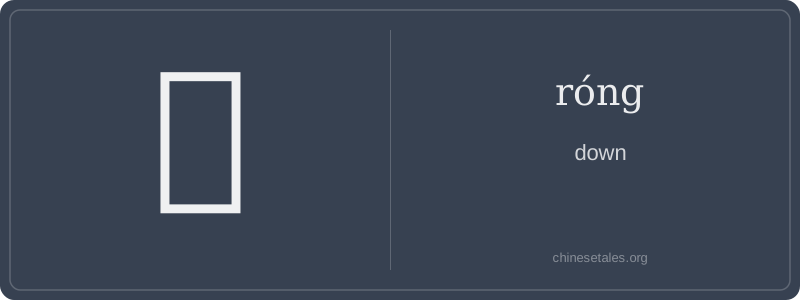
The earliest form of 毧 appears in small seal script (c. 3rd century BCE), not oracle bones — it’s too specialized for early divinatory use. Its left radical 羽 (yǔ, ‘feather’) anchors its avian identity, while the right side was originally 容 (róng), which itself meant ‘to hold, contain’ and carried phonetic weight. Visually, the character is a deliberate fusion: 羽 on the left (two symmetrical feather strokes), and 容 on the right — which in seal script looked like a roof (宀) over a mouth (口) and a woman (女), suggesting ‘a space containing softness’. Over centuries, the right side simplified into today’s 容, retaining both sound and the idea of ‘contained softness’.
This visual logic shaped its meaning: 毧 isn’t just any feather — it’s the *innermost*, most sheltered layer, the ‘contained softness’ beneath outer plumage. Classical texts like the Bencao Gangmu (Compendium of Materia Medica) used it to distinguish embryonic down from mature contour feathers. In Li Bai’s poetry, 毧 appears metaphorically — describing mist clinging to mountain peaks like newborn down — linking its biological delicacy to atmospheric subtlety. Its rarity today reflects how language sheds hyper-specific terms when ecology or technology shifts: we no longer need to name the undercoat separately when ‘down’ suffices — yet 毧 remains, a feather-soft whisper from ancient taxonomy.
Think of 毧 (róng) as the Chinese equivalent of 'down' in English — not the direction, but the soft, fluffy under-feathers of birds or fine hair on newborn mammals. It’s not about fluffiness in a general sense (that’s 绒 róng), but specifically the delicate, insulating layer that’s biologically essential and visually elusive — like trying to photograph dandelion seeds mid-air. This character carries a quiet, almost poetic precision: it appears almost exclusively in classical or literary contexts, rarely in daily speech or modern media.
Grammatically, 毧 functions as a noun and is almost always modified by classifiers like 层 (layer) or 根 (strand), or paired with verbs like 长 (to grow) or 脱 (to shed). You’ll never say *‘I have 毧’* — instead, you’d say ‘幼鸟体表覆有细密的毧’ (The hatchling is covered in fine down). It never stands alone as a subject in casual speech; it’s a lexical fossil — beautiful, precise, and politely distant.
Culturally, learners often mistake 毧 for 绒 (also róng, meaning ‘velvet’ or ‘wool’) because of identical pronunciation and similar semantic territory. But while 绒 is tactile, commercial, and ubiquitous (绒布 róngbù = velvet cloth), 毧 is biological, ephemeral, and evocative — appearing in Tang poetry to describe fledglings or in medical texts describing fetal lanugo. The biggest pitfall? Using it where 绒 would be natural — it’s like saying ‘the duck’s *down-feather* coat’ instead of just ‘down coat’ in English: technically correct, but oddly ornate and slightly off-key.