殓
Character Story & Explanation
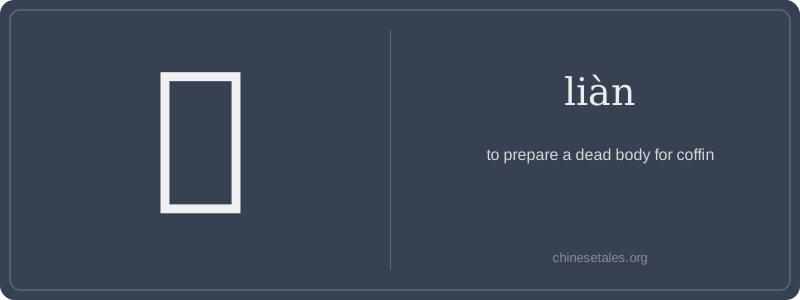
The earliest form of 殓 appears in Warring States bamboo slips as a compound glyph: the left side 歹 (a pictograph of a skeleton or corpse, originally bone fragments scattered on the ground) fused with the right side 廾 (gǒng, meaning ‘hands holding up’ — later evolving into 佥 qiān, a phonetic component suggesting ‘assembly’ or ‘standard procedure’). Over time, 廾 morphed into 佥, which itself simplified to the modern 佥 shape — two ‘people’ (人) atop a ‘box’ (一 + 口), evoking hands placing something carefully *into* a container (the coffin). Every stroke tells a story: the radical 歹 anchors it in mortality; the 佥 suggests deliberate, collective ritual action.
By the Han dynasty, 殓 was standardized in texts like the Book of Rites, where it specifically denoted the third stage of funeral rites: after death announcement (卒) and mourning preparation (奠), came 殓 — the physical encoffining. Its visual structure reinforces this: the ‘corpse’ (歹) is literally *being placed into* the symbolic ‘container’ implied by 佥’s enclosed shape. Unlike later characters for burial (葬) or mourning (哀), 殓 focuses exclusively on the body’s ceremonial readiness — a moment suspended between life’s end and earth’s embrace.
At its core, 殓 (liàn) isn’t just ‘to bury’ — it’s the solemn, ritualized act of *preparing* a corpse for its final rest: washing, dressing, placing jade or coins in the mouth, and carefully laying the body into the coffin. It carries deep cultural gravity — not a clinical or modern term, but one steeped in Confucian filial piety and ancient funerary rites. You’ll never hear it in casual speech; it appears only in classical texts, historical dramas, or formal obituaries. Grammatically, it’s a transitive verb requiring a direct object (e.g., 殓尸, 殓棺), and it almost never stands alone — you won’t say ‘I 殓’ without specifying *what* is being prepared.
Learners often misread it as ‘to bury’ (葬 zàng) or confuse it with ‘to collect’ (敛 liǎn), especially since both share the same radical 歹 and sound similar. But here’s the key: 殓 is strictly *pre-coffin* — the body must still be unburied and visible. Once interred, 殓 no longer applies. Also, note the tone: liàn (4th tone), not liǎn (3rd). Mispronouncing it can accidentally summon the homophone 敛 (to gather/collect), turning a funeral rite into a tax audit.
Culturally, 殓 reflects China’s profound belief in respectful bodily transition: the dead must be treated with dignity *before* separation from the living world. In classical sources like the Rites of Zhou, 殓 was codified as one of the ‘Five Rites’, governed by precise rules for rank, gender, and season. Today, while modern cremation has simplified practice, 殓 survives in literary language and heritage preservation contexts — a quiet linguistic fossil of ancestral reverence.