殚
Character Story & Explanation
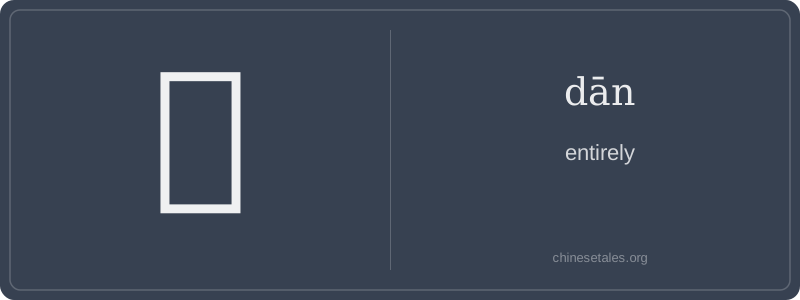
The earliest form of 殚 appears in Warring States bamboo slips as a compound: left side 歹 (a pictograph of a skeleton or exposed bones, symbolizing decay or extremity), right side 單 (dān, originally a banner on a pole — later simplified to 亶). In bronze script, 單 showed a banner atop a stand, evoking singularity and focus; combined with 歹, it suggested 'singleness of purpose pushed to the brink of exhaustion'. Over centuries, 單 evolved into 亶 (a hand holding a banner over a mouth, implying authoritative declaration), then further simplified to the modern 亶-like top-right component — losing the banner but keeping the sense of concentrated, unyielding commitment.
This visual logic cemented its meaning: 'to expend utterly'. By the Han dynasty, 殚 appears in the Shuōwén Jiězì as '尽也' ('to exhaust completely'), used in texts describing ministers who 'dān xīn jié lǜ' — pouring out heart and mind until empty. Its literary resonance deepened in Tang poetry and Song essays, where it marked moral or intellectual sacrifice. Crucially, the 歹 radical isn’t decorative — it anchors the character in gravity, reminding readers that 'entirely' here isn’t mathematical, but existential: total giving, total risk, total consequence.
Imagine a scholar in ancient Chang’an, kneeling before the emperor, sweating as he presents his memorial — not with half-measures or polite hedging, but with every last ounce of his intellect, energy, and moral courage. That’s 殚 (dān): not just 'entirely', but *exhaustively*, *unreservedly*, even *to the point of depletion*. It carries weight — the kind you feel in your bones when something is given or done without holding back, often at great personal cost. It’s never casual: you don’t ‘dān eat’ lunch; you ‘dān jīng jié lǜ’ (exhaust all mental energy) over a problem.
Grammatically, 殚 almost never stands alone. It’s a classical intensifier that lives inside four-character idioms (chéngyǔ) or formal compounds like 殚精竭虑 or 殚思极虑. You’ll see it paired with verbs like 竭 (jié, 'to exhaust') or 思 (sī, 'to think'), always emphasizing totality and effort. Learners mistakenly try to use it like 全 (quán) or 尽 (jìn) — but 殚 has no colloquial spoken life; it’s ink-and-silk territory, not WeChat text.
Culturally, 殚 reflects Confucian ideals of devotion — whether to duty, scholarship, or filial piety — where sincerity demands total investment. A common error? Misreading it as dàn (like 淡) due to tone confusion, or mistaking its 歹 radical for something harmless. Remember: 歹 means 'death/decay' — so 殚 subtly implies 'using up until nothing remains'. It’s not neutral completeness — it’s sacrificial wholeness.