殗
Character Story & Explanation
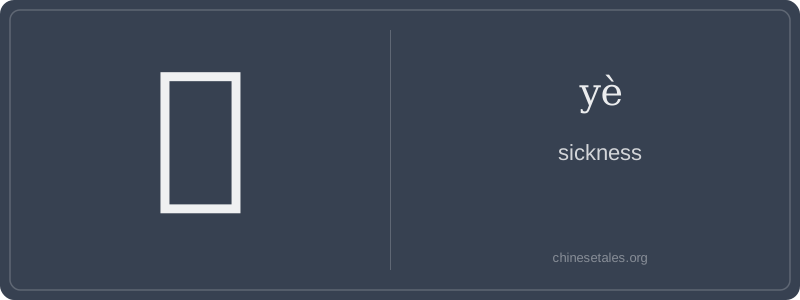
The earliest form of 殗 appears on Warring States bamboo slips as a compact, asymmetrical glyph: at top, a simplified 歹 (a bone with a crack, evoking decay), beneath it a curved stroke suggesting a bent, weakened body — not a corpse, but a person collapsing inward from within. Over centuries, the upper element stabilized into the standard 歹 radical (four strokes), while the lower half evolved from a cursive ‘body’ shape into the modern 夋 (qūn) component — originally picturing a person with limp arms and sagging spine, later stylized into three horizontal strokes and a downward hook. By the Han dynasty, the 12-stroke structure was fixed: 歹 + 夋, visually echoing collapse under invisible pressure.
This evolution mirrors its semantic journey: from concrete physical prostration (‘fainting from fever’) in early medical manuscripts like the *Huangdi Neijing*, to abstract physiological imbalance by the Tang dynasty. Du Fu once wrote of ‘yè qì fú xīn’ (sickly qi rising to the heart) — describing anxiety as bodily rebellion. The character’s very shape — a death-radical looming over a stooped figure — became a visual metaphor for illness as internal erosion, not external invasion. That’s why it survives not in clinics, but in poetry and classical diagnosis: as the ink-stain where health and decline blur.
Think of 殗 (yè) as Chinese medicine’s ‘ghost note’ — not a loud diagnosis like 病 (bìng, 'illness') or 疾 (jí, 'acute disease'), but a faint, unsettling murmur of imbalance: the kind of sickness that lingers just beneath the skin, like chronic fatigue or unexplained melancholy. In classical texts, it conveys *subclinical* or *incipient* illness — the moment your qi begins to waver before symptoms bloom. It’s never used alone in modern speech; you’ll only meet it bound in compound words or poetic allusions.
Grammatically, 殗 is strictly literary and uninflected — no verb forms, no measure words attached directly to it. You won’t say ‘I have 殗’; instead, you’ll encounter it in fixed phrases like 殗氣 (yè qì, 'sickly energy') or as part of descriptive compounds (e.g., 殗弱 yè ruò, 'constitutionally frail'). Unlike 病, which can be a noun ('a cold') or verb ('to fall ill'), 殗 is purely adjectival or nominal within compounds — always modifying or naming a *quality* of illness, never an event.
Culturally, learners often misread 殗 as a variant of 夜 (yè, 'night') due to identical pronunciation and visual similarity — a dangerous mix-up, since conflating sickness with nighttime erases its medical gravity. Also, its radical 歹 (dǎi, 'death-related') signals severity: this isn’t a sniffle — it’s illness edged with mortality. Even today, writers use 殗 for haunting, almost metaphysical ailments — think of it as the Chinese equivalent of ‘the vapours’ in Victorian English: medically vague, culturally loaded, and utterly un-Googled by HSK students.