殑
Character Story & Explanation
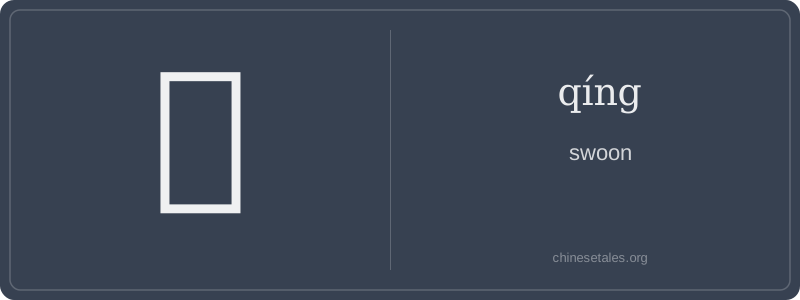
The character 殑 first appeared in late Warring States bamboo slips and early Han dynasty texts — not in oracle bone or bronze inscriptions. Its form combines the radical 歹 (dǎi, 'death/corruption') on the left with 京 (jīng, 'capital, elevated structure') on the right. Visually, 歹 suggests decay or lifelessness, while 京 originally depicted a tall watchtower — symbolizing height, exposure, and vulnerability. Over centuries, the 京 component simplified: its top stroke flattened, the middle 'mouth' shape tightened, and the bottom strokes converged into the modern four-dot base (灬), though notably, 殑 retains the original 京’s lower horizontal stroke — a rare conservative holdout.
This visual pairing tells a story: 'a person at the capital tower, overcome — falling from height into deathlike stillness.' By the Tang dynasty, 殑 was firmly established in poetry as a refined term for emotionally induced syncope — Li Bai used it metaphorically in a lament for fallen heroes, and Yuan drama scripts deployed it for heroines collapsing upon learning of their lover’s execution. The character never acquired colloquial usage; its meaning stayed frozen in literary amber — a linguistic fossil of elite emotional expression.
Think of 殑 (qíng) as Chinese literature’s dramatic fainting spell — like when a Victorian heroine collapses onto a chaise longue after hearing shocking news, fan fluttering from limp fingers. It doesn’t mean just 'to faint' in the medical sense; it evokes a sudden, emotionally triggered loss of consciousness — often poetic, gendered, and steeped in classical restraint. It’s not used in daily speech or modern medical reports (you’d say 昏倒 hūn dǎo instead); it lives almost exclusively in classical poetry, opera libretti, and stylized prose.
Grammatically, 殑 is almost always a verb, typically appearing in compact, parallel structures: ‘悲极而殑’ (bēi jí ér qíng — 'grieved to the extreme, then swooned') or ‘惊殑于庭’ (jīng qíng yú tíng — 'swooned in terror in the courtyard'). It rarely takes objects and never appears in progressive or perfective aspect markers like 了 or 着 — its power lies in its stark, unadorned finality. Learners sometimes try to use it like a modern synonym for 昏迷 (hūn mí), but that’s like using 'beseech' instead of 'ask' in a text message: technically correct, culturally jarring.
Culturally, 殑 carries a quiet feminist footnote: in Tang and Song dynasty texts, it appears disproportionately in descriptions of women collapsing under emotional duress — grief, betrayal, or filial anguish — suggesting how bodily collapse became a sanctioned, even aestheticized, outlet for emotions otherwise forbidden expression. Modern learners may overuse it trying to sound 'literary', but native speakers will hear it as archaic theater — not contemporary reality.