殄
Character Story & Explanation
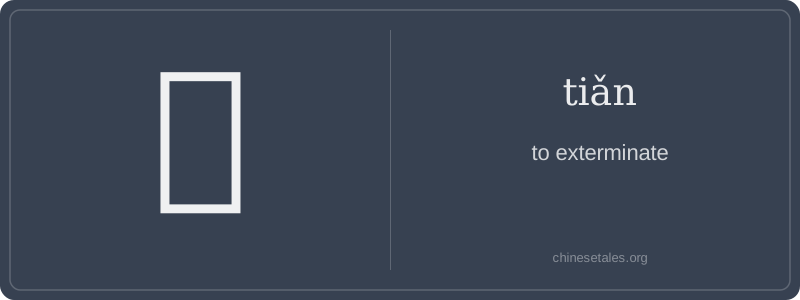
The earliest form of 殄 appears in late Shang oracle bone inscriptions as a composite: a skull-like 歹 (dǎi, ‘death/decay’) radical on the left, paired with a right-hand element resembling a kneeling figure with arms raised — possibly representing a captive being struck down *and* ritually erased. Over centuries, the right side simplified into the modern 丏 (miǎn), a stylized glyph once interpreted as ‘a person with covered eyes’ — symbolizing oblivion. By the Qin seal script, the two components fused cleanly: 歹 + 丏 = 殄, preserving both the death radical and the visual echo of irreversible removal.
This character’s meaning sharpened in Zhou dynasty bronze inscriptions, where it appeared in royal edicts declaring enemies ‘to be 殄绝’ — not merely slain, but stripped of ancestral rites and posthumous titles. The Book of Documents uses it in the phrase ‘tiǎn jué míng xìng’ (to eradicate name and lineage), revealing its legal-moral weight: to 殄 is to sever someone from cosmic and social continuity. Even today, its shape whispers this ancient logic — the 歹 radical anchors it in mortality, while 丏 suggests something deliberately blinded, silenced, and made invisible forever.
At its core, 殄 (tiǎn) isn’t just ‘to exterminate’ — it’s the visceral, total erasure of existence: not just killing, but wiping out lineage, name, and memory. Think ancient royal decrees condemning rebels to ‘be wiped from heaven and earth.’ It carries a chilling finality, often used in classical or literary contexts with moral gravity — never for casual pest control or deleting files! You’ll rarely hear it in spoken Mandarin; it lives in historical texts, formal proclamations, and poetic condemnations.
Grammatically, 殄 functions almost exclusively as a verb, usually in compound form (like 殄灭) or in classical subject-verb constructions. It rarely stands alone in modern usage — you won’t say *‘wǒ tiǎn le tā’* (I exterminated him); that sounds like a warlord’s diary entry. Instead, it appears in passive or abstract structures: *‘cǐ zú bèi tiǎn miè’* (This clan was utterly eradicated). Notice how it pairs naturally with verbs like 灭 (miè, ‘to extinguish’) or 绝 (jué, ‘to cut off’), reinforcing totality.
Culturally, learners often misread 殄 as ‘violent’ or ‘angry’ — but its power lies in cold, bureaucratic finality. Confusing it with common verbs like 杀 (shā, ‘to kill’) is a classic trap: 杀 implies an act; 殄 implies annihilation of consequence. Also, beware tone: tiǎn (third tone) sounds like ‘tian’ in ‘tianjin’ — not to be mumbled as ‘tiān’ (heaven) or ‘tiàn’ (to iron). Its rarity means even advanced learners may pause mid-sentence when encountering it in classical poetry or legal inscriptions.