殂
Character Story & Explanation
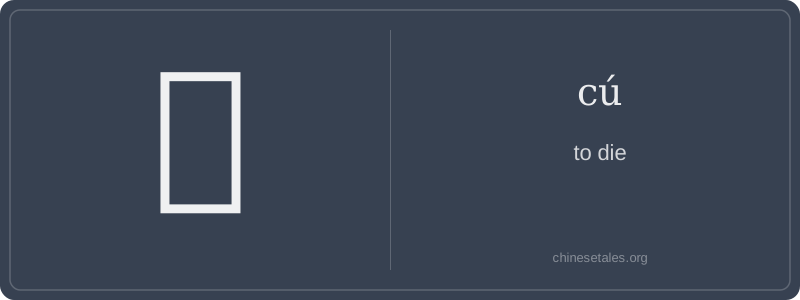
The earliest form of 殂 appears in late Warring States bamboo slips as a compound pictograph: the radical 歹 (dǎi), meaning 'death' or 'corpse', fused with 且 (qiě), which originally depicted a ritual altar with offerings — not 'and', but a sacred platform. In oracle bone inscriptions, 歹 itself was a stark, jagged bone fragment; adding 且 transformed it from mere physical decay into a ritualized, ceremonial ending. Over centuries, the 且 simplified from altar + sacrificial meat to its modern boxy shape, while the 歹 retained its grim, angular strokes — nine in total, each one echoing the weight of finality.
This visual marriage of corpse and altar cemented 殂’s meaning as 'to depart through ritual death' — not sudden or violent, but ordained, accepted, and dignified. It appears prominently in the *Zuo Zhuan* (c. 4th c. BCE) describing dukes’ deaths: '公薨,大夫皆服,君不举,以礼徂' — where 徂 (a variant) and 殂 were near-synonymous in high-register mourning. Later, during the Han and Tang dynasties, 殂 became the preferred term for imperial or elite passing, distinguishing noble exit from common demise — a linguistic class marker etched in ink and bone.
Imagine stepping into a Tang dynasty tomb — not to rob it, but to read the epitaphs carved in elegant clerical script. That’s where 殂 (cú) lives: in solemn, literary, and often ritual contexts. It doesn’t mean 'to die' in the casual, everyday sense — you’d never text '我妈殂了' to a friend. No, 殂 is elegiac, formal, and faintly archaic, carrying the hush of ancestral tablets and classical poetry. Its core feeling is dignified departure, like a scholar retiring from office — not collapsing, but withdrawing with grace and finality.
Grammatically, 殂 is an intransitive verb, almost always used in written or ceremonial registers — never with aspect particles like 了 or 过, rarely in spoken questions. You’ll find it after subject + time phrase ('先帝于贞观九年殂'), or in parallel four-character phrases like '驾崩殂落'. Unlike 死 (sǐ), which can be neutral or blunt, or 亡 (wáng), which implies loss or disappearance, 殂 suggests completion, inevitability, and quiet cessation — as if life’s flame simply went out without smoke or sound.
Learners often misread 殂 as 'to pass away' in modern contexts and insert it into conversational sentences — a subtle but jarring error, like wearing court robes to a coffee shop. It also trips people up visually: that top-right component (且) looks like 'and' (qiě), but here it’s purely phonetic (cú shares ancient roots with 且). Remember: this character breathes in classical texts, not WeChat messages.