殁
Character Story & Explanation
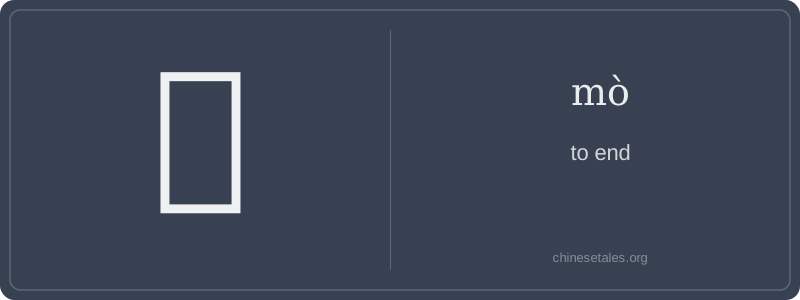
The earliest form of 殁 appears on Warring States bamboo slips as a compound pictograph: a simplified skeleton-like 歹 on the left, paired with a stylized 'mouth' or 'breath' element (originally resembling 口 or possibly a variant of ) on the right — representing the last exhalation, the final breath escaping the body. Over centuries, the right side evolved: bronze script softened the curves; seal script standardized the components; clerical script flattened the strokes; and by regular script, the right side had become 末 (mò, 'end, tip'), phonetically reinforcing the meaning while visually echoing the idea of 'the very end of life'. The eight strokes crystallized into today’s form: three for 歹 (the slanted dot, horizontal stroke, and curved hook), five for 末 (two horizontals, vertical, and two short strokes).
This evolution wasn’t accidental — 末 was chosen not just for sound but for semantic resonance: just as the 'tip' is the farthest point of a branch, 殁 marks the ultimate terminus of human existence. In the Zuo Zhuan, it appears in phrases like ‘君殁不祔’ (‘When the ruler dies, he is not enshrined [in ancestral temple]’), underscoring ritual gravity. Later, in Tang dynasty epitaphs, 殁 became the gold-standard verb for recording noble deaths — precise, reverent, and deliberately archaic, preserving its aura of solemn finality across millennia.
At first glance, 殁 (mò) feels solemn — even chilling. Its radical 歹 (dǎi) literally means 'death' or 'decay', and it appears in characters like 死 (sǐ, 'to die') and 残 (cán, 'cruel, maimed'). So 殁 isn’t just 'to end' in a neutral sense — it’s an elegant, literary, often somber ending: the cessation of life, the quiet close of a lineage, or the final stillness after decline. You’ll almost never hear it in daily speech; it lives in classical texts, epitaphs, and formal historical writing.
Grammatically, 殁 functions as a verb meaning 'to die' (especially of elders or respected figures), but with strong passive or terminal nuance — it implies inevitability, dignity, and finality. Unlike 死, which can be blunt or even colloquial ('He died'), 殁 is always transitive in classical usage and typically takes no object (e.g., ‘先父殁于庚子年’ — ‘My late father passed away in the Gengzi year’). Modern learners sometimes wrongly use it as a general synonym for ‘end’ (like 结束), but that’s ungrammatical — 殁 *only* marks biological death, never abstract conclusions.
Culturally, 殁 carries Confucian weight: it’s reserved for respectful, ritualized remembrance — you’d use it for ancestors in genealogies or official records, never for pets or fictional characters. A common mistake? Confusing its tone (mò, fourth tone) with 莫 (mò, same tone but means 'do not' or 'nothing') — same sound, utterly different spheres. Also, learners often misread its radical as 止 (zhǐ, 'to stop'), missing the crucial 'death' connotation embedded in 歹.