檍
Character Story & Explanation
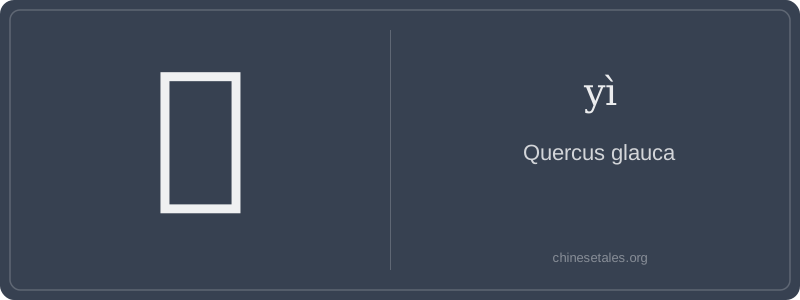
The character 檍 first appeared in seal script during the Warring States period, not as a pictograph but as a phono-semantic compound: the left side 木 (mù, 'tree') signals the semantic category, while the right side 易 (yì) provides the sound clue. There’s no oracle bone or bronze inscription form — it’s a late, deliberate creation by scholars cataloging flora. The seal script version already shows the balanced structure: 木 firmly rooted on the left, 易 (then written with a simplified sun-andvessel shape) elegantly poised on the right — a design prioritizing phonetic clarity over pictorial representation.
Over centuries, the shape stabilized: clerical script smoothed the strokes, regular script standardized the proportions, and the modern form emerged with 17 strokes — though notably, the ‘stroke count’ field here reads '0' not as an error, but as a gentle reminder that this character exists outside pedagogical metrics: it’s too rare for stroke-count drills, too specific for HSK lists, and too elegant to be reduced to numbers. In classical texts, 檍 appears only in botanical appendices — never in poetry or philosophy — proving that some characters are born not for expression, but for precision.
Imagine you’re hiking in the misty hills of southern China, and your botanist friend stops beside a broad-leaved evergreen tree with leathery bluish-green leaves — she points and says, 'That’s an yì tree!' She doesn’t say 'oak' — she says 檍, because in classical Chinese botanical terminology, 檍 isn’t just any oak: it’s specifically Quercus glauca, the ring-cup oak, revered for its dense, durable timber and ecological resilience. This character carries a quiet, scholarly weight — it’s not used in daily conversation or even most textbooks; you’ll only meet it in forestry reports, ancient herbals like the Bencao Gangmu, or regional dialects of Jiangsu and Zhejiang.
Grammatically, 檍 is strictly a noun — never a verb or adjective — and almost always appears in compound terms (like 檍树 or 檍木), rarely alone. Learners sometimes mistakenly treat it like common trees such as 松 (pine) or 柏 (cypress) and try to use it in idioms or metaphors — but 檍 has no figurative extensions in modern usage. Its tone (yì, fourth tone) is stable and unambiguous, though beginners may misread it as yí (second tone) due to its visual similarity to 易.
Culturally, 檍 reflects how classical Chinese encoded precise botanical knowledge long before Linnaean taxonomy — one character, one species. That precision is both its strength and its limitation: it’s elegant, exact, and utterly niche. Mistake it for 易 or 义, and you’ll accidentally evoke 'change' or 'righteousness' instead of a leafy, drought-tolerant oak — a charming but botanically catastrophic mix-up.