檊
Character Story & Explanation
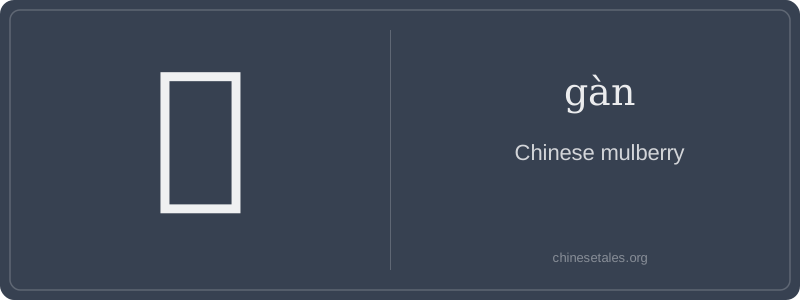
The character 檊 first appeared in seal script during the Warring States period, not as a pictograph but as a phono-semantic compound: the left side 木 (mù, 'tree') anchors its meaning, while the right side 干 (gān/gàn, 'dry, stem, trunk') provides both sound and semantic reinforcement — evoking the tree’s drought-resistant, upright, woody habit. Over time, the 干 component gained two tiny dots (丶丶) atop its horizontal stroke in clerical script, evolving into the modern 幵-like top of the right-hand element, subtly distinguishing it from plain 干. The wood radical remained stable, preserving its botanical identity across 2,300 years of script reform.
Historically, 檊 was never a ‘famous’ tree like 桑 (mulberry for silk) or 梓 (catalpa, symbol of hometown). Instead, it thrived in marginal terrain — limestone slopes, riverbanks, subtropical foothills — earning quiet respect in regional herbals like the *Bencao Gangmu* supplementaries, where its bark was noted for astringent properties. Its literary presence is sparse but telling: Tang poets used it metonymically for ‘unassuming endurance’, and Ming-era local gazetteers listed it alongside native shrubs to assert ecological authenticity. Visually, the doubled dots over 干 suggest ‘two eyes watching the trunk’ — a folk memory of how villagers identified it by its distinctive lenticels and fissured bark.
Think of 檊 (gàn) like the 'oak' of Chinese botany — not just a tree, but a quietly noble, deeply rooted native species that shows up in classical texts and regional ecology, not everyday conversation. It refers specifically to the Chinese mulberry (Morus australis), a hardy, drought-tolerant relative of the white mulberry — but unlike the silkworm-famous *Morus alba*, this one’s more about resilience than industry. You’ll almost never hear it in spoken Mandarin; it lives in botanical manuals, local floras, and the occasional poetic line about mountain groves — like finding 'sycamore maple' in an English novel: precise, evocative, and slightly archival.
Grammatically, 檊 is strictly a noun — no verb forms, no adjectival uses, no colloquial contractions. It doesn’t pluralize, compound freely, or take aspect particles. It appears only in formal or scientific contexts: 'a stand of 檊 trees', 'the bark of 檊', 'native to the Yangtze basin'. Learners sometimes try to use it like 桑 (sāng, common mulberry) — but that’s like swapping 'red oak' for 'oak' generically: technically related, but botanically and linguistically distinct. Using 檊 where 桑 is expected sounds like citing 'Quercus rubra' at a backyard barbecue.
Culturally, its rarity is the point: 檊 signals precision, locality, and ecological specificity. Mistaking it for 桑 or 杆 (gān, pole) is common — both share the gàn pronunciation and visual echoes — but doing so erases centuries of regional plant knowledge. In southern China, elders may still name hillsides after 檊 groves, but you won’t find it on menus, apps, or street signs. Its silence in modern speech isn’t neglect — it’s botanical gravitas.