柽
Character Story & Explanation
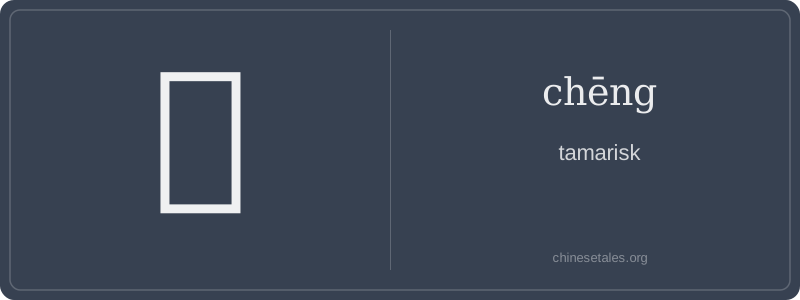
The earliest form of 柽 doesn’t survive in oracle bones, but its structure tells a clear story: left side 木 (mù, 'tree') is unchanged since bronze script — a stylized trunk with roots and branches. Right side is 呈 (chéng, 'to present'), which itself evolved from a hand holding a ritual vessel — in small seal script, it became a compact + 王 shape. By the Han dynasty, scribes fused these two elements into a balanced 9-stroke character: the 木 radical firmly grounded on the left, and 呈 streamlined into three horizontal strokes above a vertical stroke and a final捺 (nà) — giving 柽 its distinctive upright, slightly austere silhouette, mirroring the tamarisk’s own slender, wind-swept form.
Historically, 柽 entered written records relatively late — first appearing reliably in Ming and Qing botanical texts like Plant Names Illustrated (《植物名实图考》), where it was noted for ‘growing where water meets sand, unafraid of salt’. Classical poets rarely used it (unlike willow or plum), but modern ecologists revived it as a symbol of ecological pragmatism. Its visual logic is elegant: 木 says ‘this is a woody plant’, and 呈 — pronounced identically (chēng) — acts as both phonetic clue and semantic nudge: this plant *presents* itself boldly in harsh terrain, impossible to overlook once you know its name.
At first glance, 柽 (chēng) seems like a botanical footnote — just the name for tamarisk, that tough, salt-tolerant shrub with feathery pink flowers you’ll spot along China’s arid northwest rivers and deserts. But in Chinese, this character carries quiet ecological gravitas: it’s not just *a* plant, but *the* plant of resilience — the one that holds sand dunes in place, survives in alkaline soil where rice or bamboo would perish, and appears in official reforestation reports as a silent hero. You’ll almost never hear it in casual speech (hence its absence from HSK), but in scientific, environmental, or regional literature — especially from Xinjiang, Inner Mongolia, or Gansu — it shows up with quiet authority.
Grammatically, 柽 is strictly a noun and rarely stands alone. It nearly always appears in compounds (like 柽柳 or 柽柳林) or in descriptive phrases where its function is taxonomic and precise — think of it like 'ginkgo' in English: you wouldn’t say *'I saw a ginkgo'* without context, but *'the ginkgo biloba grove'*? Absolutely. Learners sometimes mistakenly treat it as a verb ('to tamarisk') or try to pluralize it with 们 — a no-go: 柽 has no plural form and no verbal derivation. It’s a proper botanical label, not a colloquial word.
Culturally, 柽 reveals how Chinese language encodes ecological wisdom in single characters: its 木 (tree) radical anchors it in the plant world, while the right side 呈 (chēng, 'to present, display') subtly evokes how this plant *presents itself* — upright, persistent, unmistakable against barren land. A common mistake? Pronouncing it chēn (missing the second tone) — but more importantly, confusing it with similar-looking characters like 呈 or 程. Remember: if it’s about desert restoration, riverbank stability, or Xinjiang botany — it’s 柽.