檄
Character Story & Explanation
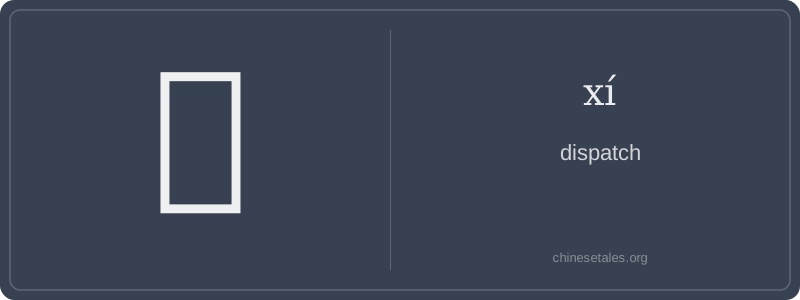
The earliest form of 檄 appears in Han dynasty bamboo slips — not oracle bones, but still ancient. Its left side 木 (mù, 'tree/wood') is literal: early 檄 were inscribed on wooden tablets called 木簡 (mùjiǎn). The right side is more intriguing: it evolved from the ancient character 敵 (dí, 'enemy'), simplified over centuries into the modern 戾 + 丿 structure. Originally, it depicted a wooden tablet held aloft *against* an enemy — a visual pun linking medium (wood) and mission (denunciation). Stroke-by-stroke, the top 丶 and 丿 suggest urgency, like a raised finger pointing; the central 'mouth' radical (口, embedded in 戾) hints at spoken accusation made permanent in writing.
By the Warring States period, 檄 had crystallized as a genre: official proclamations read aloud before troops, then nailed to city gates. Ban Gu’s Book of Han records generals issuing 檄 to expose enemy cruelty — turning words into psychological weapons. The character’s shape mirrors its function: solid as wood (木), sharp as accusation (the angular, tense strokes of 戾), and unignorable as a call to action. Even today, when Chinese historians say a text 'has the spirit of an 檄', they mean it doesn’t inform — it incites, condemns, and commands attention.
Think of 檄 (xí) as China’s ancient equivalent of a viral Twitter thread — but carved on wood, sealed with authority, and designed to ignite public outrage or mobilize armies. It’s not just any 'dispatch'; it’s a formal, incendiary proclamation — often polemical, always urgent, usually issued by a ruler or rebel leader to justify war, denounce tyranny, or rally support. Unlike neutral terms like 通知 (tōngzhī, 'notice') or 公告 (gōnggào, 'announcement'), 檄 carries rhetorical heat: it’s the written equivalent of a drumbeat before battle.
Grammatically, 檄 is almost always a noun — you’ll see it in compounds like 讨伐檄 (tǎofá xí, 'denunciatory proclamation') or as the object of verbs like 发布 (fābù, 'to issue') or 撰写 (zhuànxiě, 'to draft'). You won’t say *'I xí-ed him'* — it doesn’t verbify like English 'dispatch'. Learners sometimes mistakenly use it for routine emails or memos; that’s like mailing a papal bull to your landlord about rent. Correct usage demands gravitas: think historical weight, not inbox clutter.
Culturally, 檄 evokes literary mastery — the most famous is 駱賓王’s Exhortation Against Wu Zhao (《討武曌檄》), whose blistering rhetoric allegedly made Empress Wu herself pause mid-sentence and sigh, 'Such talent wasted on rebels!' Mistake this character for a generic 'document', and you’ll miss its soul: it’s not paperwork — it’s weaponized rhetoric, chiseled in wood and sharpened with ink.