檃
Character Story & Explanation
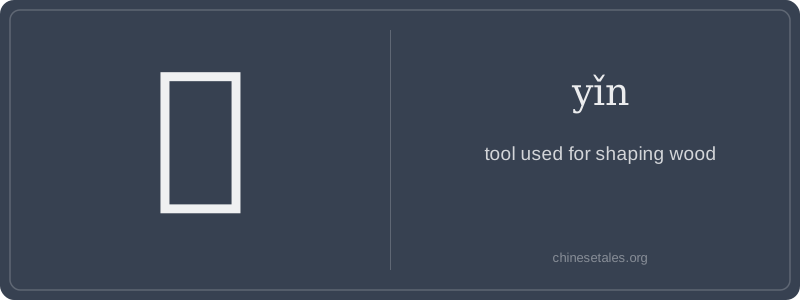
The earliest form of 檃 appears in Han dynasty seal script, not oracle bones — it’s too specialized for early divination. Visually, it merges 木 (mù, 'tree/wood') on the left with 隠 (yǐn, an archaic variant of 隱, 'to conceal') on the right — but crucially, that right side evolved from a pictograph of a *curved metal clamp pressing down on bent wood*, not a person hiding. Over centuries, the clamp simplified into the 隠 shape we see today, while the left 木 remained anchor and semantic clue: this tool works *on wood*.
By the Warring States period, 檃 was documented in the *Kao Gong Ji* (Record of Trades), describing how master carpenters used bronze-tempered 檃 tools to bend bamboo strips for crossbow stocks — ensuring perfect tension without snapping. Later, scholars like Liu Xie in the *Wen Xin Diao Long* (6th c. CE) repurposed 檃括 metaphorically: just as the tool bends wood *without breaking it*, good writing must be shaped with restraint and respect for its raw material. The character’s visual weight — that heavy, enclosing right side — mirrors its function: firm, patient, and unyielding in its standard.
檃 (yǐn) is a rare, specialized character — think of it as the 'wood-bending iron' of ancient Chinese carpentry. Its core meaning isn’t just 'tool' but specifically a curved metal or wooden jig used to straighten warped timber or shape flexible wood *before* carving — like a pre-industrial calibrator for precision joinery. It’s not a verb on its own; you won’t say 'I 檃 the plank.' Instead, it appears almost exclusively in classical compounds like 檃括 (yǐn kuò), meaning 'to correct, refine, or bring into proper form' — metaphorically extending the carpenter’s craft to literary or moral refinement.
Grammatically, 檃 functions only within compound nouns or verbs, never standalone. Learners often misread it as a verb root or confuse it with similar-sounding characters like 引 (yǐn, 'to pull'), but 檃 carries no action force — it’s static, structural, and deeply tactile. You’ll find it in phrases like '檃括文章' (refining an essay’s structure), where the image is of gently coaxing unruly material into elegant alignment, not forcing change.
Culturally, this character embodies a quiet Confucian ideal: cultivation through gentle, skilled intervention — not brute correction. Modern readers rarely encounter it outside classical texts or scholarly discussions, so mistaking it for 引 or 隐 is common. But remember: 檃 doesn’t 'pull' or 'hide' — it *holds in true form*. Its rarity means context is everything: if you see it, you’re likely reading Tang dynasty poetry or Song dynasty craft manuals — not ordering noodles.