樨
Character Story & Explanation
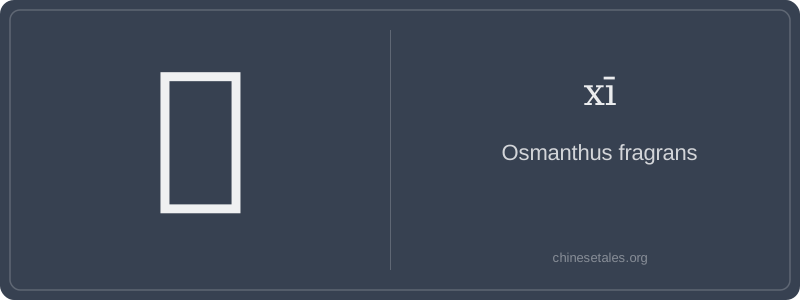
The earliest form of 樨 doesn’t appear in oracle bones—it emerged later, during the Warring States period, as a phono-semantic compound. Its left side 木 (mù, 'tree') anchors it firmly in the plant realm, while its right side 奚 (xī) was borrowed purely for sound—no semantic connection to 'servant' or 'how', as 奚 usually implies. Visually, the modern 16-stroke form crystallized by the Han dynasty: 木 (4 strokes) + 奚 (12 strokes)—a clean division where the top two strokes of 奚 (the 'scaffold' radical ⺈ plus 人) sit neatly above the lower 可-like structure, mimicking the delicate branching of an osmanthus shrub.
Its meaning stayed remarkably stable: from early medical texts like the *Shennong Bencao Jing* (1st c. CE), 樨 referred specifically to the fragrant evergreen tree *Osmanthus fragrans*. By the Tang and Song dynasties, poets like Yang Wanli celebrated 木樨 (mùxī) not for showy blooms but for invisible, pervasive scent—'fragrance without form'. The character’s visual restraint (no flowery embellishments, no radical suggesting scent) ironically mirrors that very quality: the power of 樨 lies in what you *smell*, not what you see—a silent, elegant paradox encoded in its balanced, unadorned strokes.
At its heart, 樨 (xī) isn’t just a botanical label—it’s a sensory time capsule. This character names *Osmanthus fragrans*, the small, golden-yellow or creamy-white flower whose intoxicating, honeyed aroma drifts through autumn air across southern China and beyond. Unlike generic terms like 花 (huā, 'flower'), 樨 carries poetic weight: it evokes nostalgia, quiet elegance, and seasonal rhythm—think mooncakes scented with osmanthus syrup or grandma’s dried blossoms in a porcelain jar. You’ll almost never see 樨 alone; it’s always part of compound nouns like 桂花 (guìhuā) or 木樨 (mùxī), where it functions exclusively as a noun root—not a verb, adjective, or modifier.
Grammatically, 樨 is strictly a literary or formal synonym for 桂花, used especially in classical poetry, botanical contexts, or regional dialects (e.g., Jiangsu/Zhejiang). Learners often mistakenly treat it as interchangeable with 桂 (guì, 'cassia' or 'osmanthus' in broader contexts), but 樨 appears only in set phrases—never in modern colloquial speech like 'I smell osmanthus!' (that’s 桂花香, not 樨香). And no, you won’t find it in verbs, adjectives, or HSK textbooks—it’s a quiet specialist, not a workhorse character.
Culturally, 樨 subtly bridges nature and refinement: in Ming-Qing literati culture, planting 木樨 trees symbolized scholarly virtue—because their fragrance is subtle yet persistent, like quiet wisdom. A common learner trap? Writing 樨 as 桂 (which means both 'cassia' and 'osmanthus') and missing the nuance: 桂 is broad and administrative (e.g., Guangxi’s old name 桂林, ‘Forest of Cassia’); 樨 is precise, floral, and aromatic. Confusing them is like calling a lavender bush 'rosemary'—technically related, but botanically and poetically off-key.