樧
Character Story & Explanation
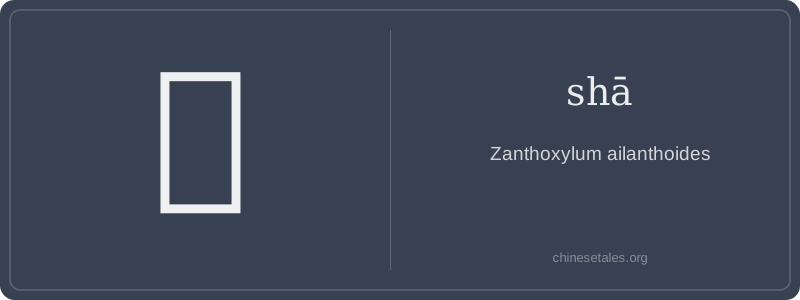
The earliest form of 樧 appears in seal script (around 3rd century BCE), where it clearly combines two semantic elements: the 'tree' radical (木) on the left — signaling botanical nature — and the right-hand component, which evolved from 叚 (jiǎ), an ancient variant of 假 meaning 'borrowed' or 'artificial', but here serving primarily as a phonetic hint (shā). Over centuries, 叚 simplified visually: its top horizontal stroke merged with the vertical, the inner 'mouth' shape became a compressed 甲-like form, and the lower part smoothed into the modern 丷 + 日 structure — resulting in today’s elegant, slightly angular right side. The left 木 stayed resolutely woody and grounded.
This character first appeared in the Shuowen Jiezi (121 CE), China’s first dictionary, defined tersely as 'a tree whose bark treats wind-dampness' — confirming its medicinal roots. By the Tang dynasty, poets avoided it (too technical!), but herbalists relied on it precisely because it distinguished this particular prickly ash from other Zanthoxylum species. Visually, the contrast between the sturdy 木 and the intricate, almost 'layered' right side mirrors the plant itself: deeply rooted, yet covered in complex, layered bark and sharp spines — a perfect logographic portrait in ink.
Let’s be honest: 樧 (shā) is a botanical deep-cut — not something you’ll need for ordering dumplings or booking train tickets. It refers specifically to Zanthoxylum ailanthoides, a prickly, aromatic Sichuan pepper relative native to East Asia, sometimes called 'Japanese prickly ash' or 'toothache tree' (yes, its numbing compounds really do dull pain!). In Chinese, it’s a noun-only character — never used as a verb or adjective — and almost always appears in scientific, herbal, or regional ecological contexts. You’ll rarely see it outside of botanical texts, traditional medicine references, or local forestry reports.
Grammatically, 樧 behaves like any monosyllabic plant name: it can stand alone ('这棵是樧'), appear after measure words ('一株樧'), or combine into compound nouns (e.g., 樧木, 樧叶). Crucially, it’s *not* interchangeable with the far more common 花椒 (huājiāo) — that’s the everyday Sichuan pepper; 樧 is its wild, less-cultivated cousin. Learners sometimes misread it as 沙 (shā, 'sand') due to identical pronunciation and similar stroke rhythm — but confusing them turns a forest inventory into a desert report!
Culturally, 樧 carries quiet significance: in classical herbals like the Bencao Gangmu, it was noted for its pungent bark and medicinal use against rheumatism and toothaches — hence its folk name 'toothache tree'. Modern usage is highly specialized: think biodiversity surveys in Fujian mountains or ethnobotanical studies, not restaurant menus. Its rarity means it’s a great litmus test — if you know 樧, you’re not just learning characters; you’re reading Chinese like a field botanist.