槭
Character Story & Explanation
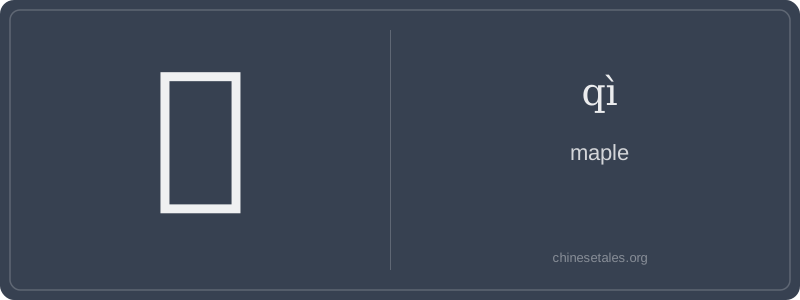
The earliest form of 槭 doesn’t appear in oracle bones (too specific for early divination), but its structure reveals its origin clearly: left side 木 (mù, 'tree') anchors it as a woody plant; right side is 又 (yòu, 'again') plus 氵 (shuǐ, 'water') — wait, no! Actually, the right-hand component is 摵 (sè), an archaic character meaning 'to shake' or 'to rustle', later simplified into the modern 槭’s right side (which looks like 又 + 氵 but historically derives from 摵’s phonetic core). Over centuries, scribes streamlined 摵’s complex form, merging strokes until it settled into today’s elegant 15-stroke shape — a tree (木) whose leaves *rustle* (evoking the whispering sound of maple leaves in wind).
This visual-poetic link endured: classical texts like the *Qun Fang Pu* (17th-c. botanical compendium) used 槭 to distinguish true maples (*Acer* spp.) from lookalikes, praising their ‘crisp rustling’ and vivid autumn hues. In Tang poetry, though 枫 dominates imagery, 槭 appears in medicinal manuals for its bark’s astringent properties — linking its ‘shaking’ etymology to the trembling motion of harvesting sap or stripping bark. Even today, the character’s flowing strokes mimic the jagged silhouette of a maple leaf — especially when written in cursive script, where the final three strokes swoop like falling foliage.
Think of 槭 (qì) as Chinese botany’s answer to the maple syrup aisle at Whole Foods — instantly recognizable by its leaf shape, yet quietly exotic in everyday Mandarin. Unlike common trees like 松 (pine) or 柳 (willow), 槭 isn’t a household word for most native speakers; it’s a precise, almost botanical term used mainly by gardeners, foresters, and autumn photographers — not your auntie describing the backyard tree. You’ll rarely hear it in casual speech; instead, people say 枫树 (fēngshù) for 'maple' in general contexts, making 槭 feel like the Latin *Acer* on a plant label: accurate, scholarly, and slightly hushed.
Grammatically, 槭 functions exclusively as a noun — never as a verb or adjective — and almost always appears in compounds (e.g., 槭树, 槭叶) or with classifiers like 一棵 (yī kē, 'one tree'). Crucially, it’s *not* interchangeable with 枫: while both mean 'maple', 枫 is colloquial and poetic (think ‘maple-red sunset’), whereas 槭 is taxonomic and neutral — like swapping 'oak' for *Quercus*. Misusing 槭 where 枫 fits (e.g., saying *槭红* instead of *枫红*) sounds like saying 'acer-red' at a poetry reading: technically correct, but jarringly clinical.
Culturally, 槭 carries quiet prestige: it’s the tree behind Japan’s famed *momiji-gari* (maple-leaf viewing), and in China, rare species like the endangered 天目槭 (Tiānmù qì) are studied in conservation circles. Learners often misread its tone (it’s fourth tone — sharp and falling, like a leaf dropping), or confuse it with 易 (yì) due to the shared 又 component. But here’s the kicker: despite 15 strokes, 槭 isn’t in HSK because it’s simply too niche — a reminder that Mandarin’s vocabulary blooms far beyond textbooks, in forests and field guides.