椁
Character Story & Explanation
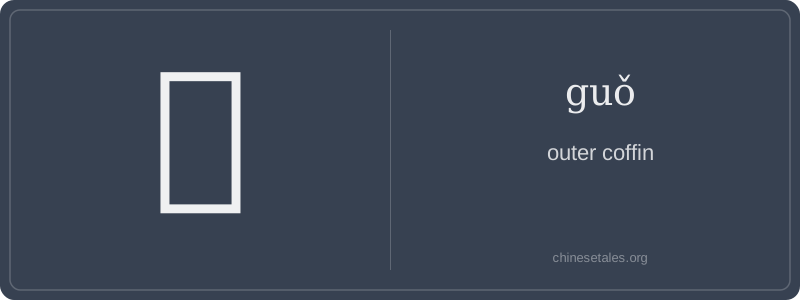
The earliest form of 椁 appears in Warring States bamboo slips as a pictograph showing two parallel horizontal strokes (representing planks) sandwiching a vertical stroke (a supporting post), all enclosed by a frame-like structure — unmistakably a layered wooden casing. Over time, the frame simplified into the right-side component 享 (xiǎng), which originally depicted a sacrificial altar with offerings, subtly reinforcing the ritual function of the outer coffin. Meanwhile, the left-side 木 (wood) radical was added unambiguously to stress materiality — because in ancient China, only fine, seasoned wood (like catalpa or nanmu) was deemed worthy for this sacred enclosure.
By the Han dynasty, 椁 had crystallized into its current shape: 木 + 享. The 'offering altar' component 享 wasn’t arbitrary — it echoed the belief that the outer coffin served as a ritual platform for ancestral veneration, separating the deceased from chaos (the earth) while presenting them to heaven. In the Book of Rites, it’s specified that nobles of different ranks were entitled to specific numbers of 椁 layers — three for dukes, two for ministers — making it a silent marker of social hierarchy. Even today, when archaeologists unearth a lacquered 椁 in Mawangdui or Mancheng, they’re not just finding wood — they’re reading a royal decree in timber.
Think of 椁 (guǒ) as the 'coffin’s outer shell' — not just any box, but the protective wooden layer that encases the inner coffin (槨) in ancient Chinese burial rites. It’s a highly specialized, literary term rooted in ritual archaeology and classical texts; you’ll almost never hear it in modern spoken Mandarin, and it’s absent from daily life or even most history textbooks unless you’re studying Han dynasty tombs or reading the Rites of Zhou. The character feels solemn, weighty, and distinctly pre-modern — like stepping into a lacquered tomb chamber.
Grammatically, 椁 functions exclusively as a noun, typically appearing in compound nouns (e.g., 外椁) or with measure words like 具 (yī jù guǒ — 'one outer coffin'). It never appears as a verb or adjective, nor does it take aspect particles (了, 过) or modifiers like adjectives — trying to say *漂亮的椁* sounds deeply unnatural to native ears. Its usage is tightly bound to archaeological reports, museum labels, and classical commentary: always contextualized, never standalone.
Culturally, 椁 reflects China’s layered cosmology of death: the body rests in an inner coffin (棺), wrapped in a middle coffin (槨), then sealed within the outer coffin (椁) — each layer symbolizing increasing distance from the mortal world. Learners often misread it as 槨 (also guǒ, but meaning 'middle coffin') or confuse it with 郭 (guō, 'city wall'), due to similar pronunciation and radical proximity. But 椁 is strictly wooden (木 radical) and strictly outer — no exceptions.