椠
Character Story & Explanation
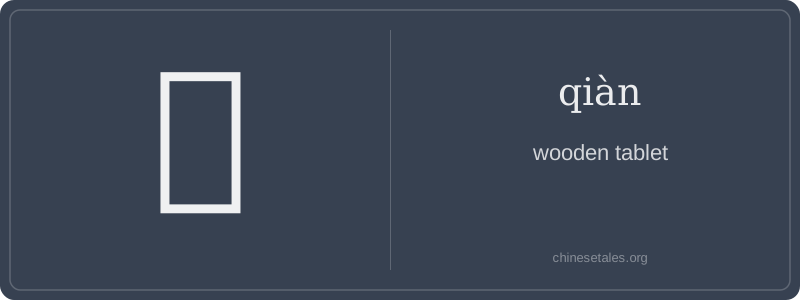
The earliest form of 椠 appears in seal script as a clear pictograph: on the left, 木 (mù), the 'tree/wood' radical, grounding it in material reality; on the right, a stylized depiction of a flat, rectangular slab with faint horizontal lines — representing the smoothed surface ready for inscription. Over time, the right side evolved from a simple rectangle into the modern component 欠 (qiàn), which originally depicted a person stretching upward (as in 'yawning'), but here serves purely as a phonetic hint — though ironically, 欠 and 椠 share pronunciation, not meaning. The twelve strokes consolidate this duality: solidity (wood) + preparedness (flat, ruled surface).
By the Warring States and Han periods, 椠 referred specifically to high-quality, finely planed wooden tablets used by officials and scholars — distinct from rougher bamboo slips (简, jiǎn). In the Shuōwén Jiězì (121 CE), Xu Shen defines it as 'a board for writing, made of wood', emphasizing craftsmanship. Poets like Li Bai later used it metaphorically — 'ink-stained 椾' implied sincerity etched in permanence. Even today, calligraphers sometimes refer to their practice boards as 椾, honoring the character’s enduring link between material precision and expressive intent.
Think of 椠 (qiàn) not as just 'wooden tablet' but as a quiet artifact of pre-paper China — a smooth, planed plank of wood used for writing before paper existed. It’s not about lumber or furniture; it’s about *intentional surface*: a blank yet dignified medium for recording oaths, contracts, or poetry. The character breathes stillness and formality — you’ll almost never hear it in casual speech, but it appears with weight in classical texts or museum labels. Its feel is tactile and archival: imagine running your fingers over grain-marked wood inscribed with ink that’s survived centuries.
Grammatically, 椠 functions almost exclusively as a noun, often in literary or historical compounds. It rarely stands alone — you won’t say 'I bought a 椠' — but you *will* see it in phrases like 竹椾 (zhú qiàn, bamboo tablet) or 书椾 (shū qiàn, written tablet). Unlike common nouns such as 纸 (zhǐ, paper), 椠 has no verb forms or colloquial derivatives; it resists modernization. Learners sometimes misread it as 槛 (kǎn, threshold) or 剑 (jiàn, sword) due to the right-side component — but those are phonetically unrelated traps.
Culturally, 椠 evokes the tactile intimacy of early Chinese literacy: scribes carving characters into bamboo strips bound with silk, or brushing ink onto polished wooden tablets. Mistaking it for a generic 'wood object' misses its ceremonial resonance — it was the physical substrate of authority and memory. Modern usage is almost entirely scholarly or poetic; spotting 椠 in a text is like finding a watermark from the Han dynasty. Don’t force it into daily conversation — let it sit gracefully in your mental museum of ancient tools.