槥
Character Story & Explanation
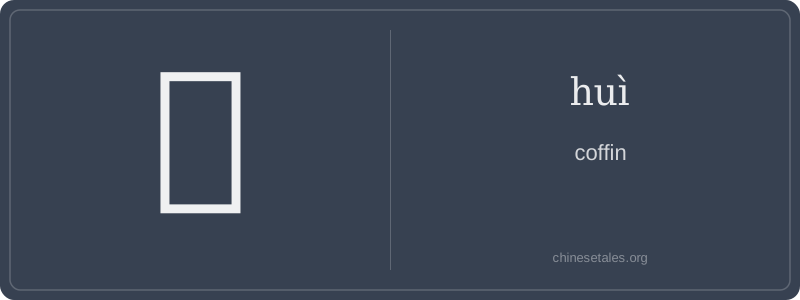
The earliest form of 槥 appears not in oracle bones but in Warring States bamboo slips and Han dynasty seals — and it’s strikingly literal. The left radical 木 (mù, 'tree/wood') anchors its meaning in materiality, while the right side, originally written as 會 (huì, 'to gather, assemble'), was both phonetic and semantic: coffins were literally 'assembled wooden vessels'. Over centuries, 會 simplified into the modern 殳-like component (but note: it’s not the weapon radical 殳 — a common misconception!), losing its original pictorial clarity but preserving the huì pronunciation and the idea of careful, ritual construction.
This character breathes with Confucian restraint: unlike flamboyant funeral terms, 槥 carries connotations of humility and frugality — virtues praised in mourning rites. The Book of Rites (Lǐjì) mentions 槥 in passages regulating burial simplicity for scholars and commoners, contrasting it with ornate coffins for nobles. Its visual structure — wood + assembly — quietly insists that death, however solemn, must be grounded in natural material and human labor, not spectacle. Even today, when a novelist writes 槥, readers feel the grain of plain wood, the hush of a modest farewell.
At first glance, 槥 (huì) feels like a quiet, almost ghostly character — it means 'coffin', but not the everyday kind. It’s a literary, classical term, rarely heard in modern speech or even formal funerals today. In contemporary Chinese, people say 棺材 (guāncái) or just 棺 (guān); 槥 is reserved for poetry, historical novels, or solemn classical allusions — think of it as the 'Shakespearean coffin': elegant, archaic, and heavy with unspoken sorrow. Its tone is hushed, respectful, and deeply traditional.
Grammatically, 槥 functions as a noun and almost never appears alone in speech; it’s embedded in compounds (like 棺槥 or 槥木) or used in fixed literary phrases. You won’t say 'I bought a 槥' — instead, you’ll find it in passive, ritualistic constructions: '以桐为槥' ('made the coffin from paulownia wood') or in compound nouns where it pairs with other funeral-related characters. It doesn’t take measure words like 个 or 只 — that’s a red flag for learners: if you’re trying to quantify it, you’re probably misusing it.
Culturally, 槥 reveals how precisely Chinese encodes social hierarchy and ritual propriety through vocabulary. In ancient texts, the material, size, and even the character used for 'coffin' signaled the deceased’s rank — 槥 specifically denoted a simple, modest wooden coffin, often for those of lower status or during times of hardship. Learners mistakenly assume it’s a neutral synonym for 'coffin'; in reality, using it outside classical contexts can sound either absurdly poetic or unintentionally dismissive — like calling a modern hospital 'a hall of pulse-reading' instead of 'a clinic'.