梿
Character Story & Explanation
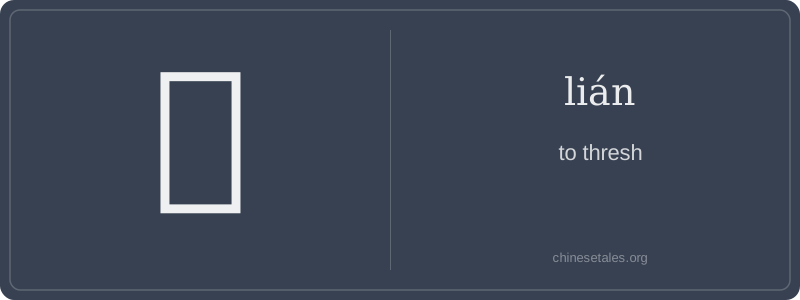
The earliest form of 梿 appears in Han dynasty bamboo slips as a combination of 木 (wood) on the left and 連 (lián, ‘to connect’) on the right — but crucially, not for meaning. The oracle bone and bronze script precursors are lost, yet seal script shows clear intent: the left side anchors the action in material (wooden flail), while the right side, though borrowed for sound, visually echoes linked strokes — mimicking the back-and-forth motion of swinging and striking. Over centuries, the top of 連 simplified from 辶+車 to 車-less forms, and the lower part stabilized into the modern 连-like shape — all while keeping the core idea: wood-in-motion against grain.
By the Eastern Han, 梿 was codified in agricultural treatises like Fan Shengzhi Shu (《氾勝之書》) as the essential step before winnowing. Classical poets avoided it — too prosaic — but farmers knew it intimately. Interestingly, its visual structure reinforces function: the 木 radical isn’t decorative; it signals that the tool must be wooden (bamboo or hardwood flails were standard), and the eleven strokes themselves mimic the rhythm of two beats — lift (first five strokes), strike (last six). Even today, in Shaanxi folk songs, the word lián appears in call-and-response chants about harvest — preserving the character’s kinetic soul.
Imagine standing in an ancient grain field, holding a flail — not to fight, but to separate golden rice kernels from their husks. That’s 梿 (lián): the precise, rhythmic act of threshing — beating stalks to loosen edible grains. It’s not generic ‘harvesting’ or ‘grinding’; it’s the physical, labor-intensive step between reaping and winnowing. The character feels grounded, rustic, and purposeful — like wood meeting grain with intention.
Grammatically, 梿 is almost always a verb, typically transitive and often paired with objects like 稻 (dào, rice), 麦 (mài, wheat), or 秸秆 (jiēgǎn, stalks). You’ll rarely see it alone: it needs what’s being threshed. In classical texts, it appears in passive constructions (e.g., ‘稻已梿’) or as part of compound verbs like 梿打 (lián dǎ), where 梿 specifies the tool-motion and 打 adds force. Modern usage is rare outside agricultural history or dialect literature — so learners won’t hear it on the subway, but they *will* trip if they confuse it with similar-sounding characters in classical reading.
Culturally, 梿 evokes pre-industrial rural China — think Ming dynasty farming manuals or Tang poems describing autumn labor. A common mistake? Assuming it means ‘to link’ (like 连) because of the sound lián — but no connection exists! Also, learners sometimes misread the right side as 莲 (lotus) and imagine poetic imagery, when in fact it’s a phonetic component (連) that only hints at pronunciation, not meaning. Its wooden radical 木 reminds us: this action requires a wooden tool — a flail, not a machine.