榴
Character Story & Explanation
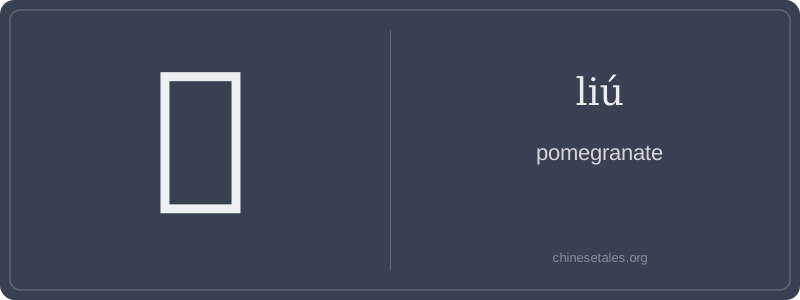
The earliest form of 榴 appears not in oracle bones but in seal script (c. 3rd century BCE), where it’s already clearly composed of two parts: 木 (‘tree’, the radical, on the left) and 留 (liú, phonetic component, on the right). The 木 radical signals it’s a woody plant — fitting, since pomegranates grow on deciduous shrubs or small trees. The right side, 留, originally depicted a ‘spear tip piercing soil’ (strokes resembling 厶 + 田 + 刀), evolving into its modern shape meaning ‘to stay, detain’. Here, it’s purely phonetic — lending the sound liú, not the meaning.
By the Han dynasty, 榴 was firmly established for ‘pomegranate’, introduced from Persia via the Silk Road around the 2nd century BCE. Its first major literary appearance is in the *Book of Han*, describing exotic plants brought back by Zhang Qian. Interestingly, the character’s visual structure mirrors its botanical reality: 木 anchors it in nature; 留’s dense, layered strokes subtly echo the tightly packed arils inside the fruit — a serendipitous visual rhyme between form and function that ancient scribes couldn’t have planned but modern learners can cherish.
Imagine walking through a Beijing hutong in autumn, where an elderly auntie hands you a split pomegranate — its ruby seeds glistening like tiny jewels. That vibrant, jewel-toned fruit is the heart of 榴 (liú). In Chinese, this character doesn’t just name the fruit; it evokes abundance, fertility, and auspiciousness — so much so that ‘pomegranate seeds’ (石榴子) are a poetic metaphor for many children or descendants. It’s almost always used in compounds: standalone 榴 is rare, and saying *just* ‘liú’ sounds incomplete, like saying ‘pomegranate’ without context in English.
Grammatically, 榴 appears exclusively in fixed nouns — never as a verb or adjective. You’ll see it in 石榴 (shí liú, ‘pomegranate’), 石榴树 (shí liú shù, ‘pomegranate tree’), or even brand names like 石榴酒 (shí liú jiǔ, ‘pomegranate wine’). Learners often mistakenly treat it as a free-standing noun or try to pluralize it (e.g., *liús*) — but Chinese doesn’t inflect, and 榴 has no independent usage. Also, don’t confuse it with homophones like 流 (liú, ‘to flow’) — they share pronunciation but zero semantic overlap.
Culturally, the pomegranate symbolizes prosperity because one fruit holds hundreds of seeds — a visual metaphor for flourishing lineage. In classical poetry, it’s linked to Tang dynasty elegance and imperial gardens; today, it’s common in wedding motifs and New Year decorations. A frequent error? Writing 榴 instead of 琉 (as in 琉璃, ‘glass’) — both have 木 on the left, but the right side is completely different. Remember: 榴 grows on trees; 琉 is man-made glass.