榱
Character Story & Explanation
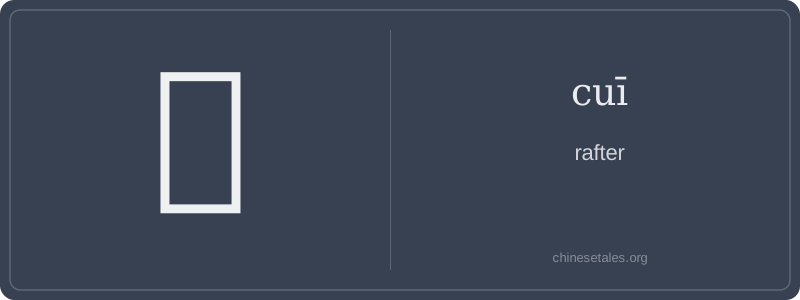
The earliest form of 榱 appears in bronze inscriptions as a stylized pictograph: a pair of parallel horizontal lines (representing wooden beams) above a simplified 'tree' shape — no radical yet, just pure visual shorthand for 'roof-supporting wood'. Over centuries, the top became more angular, the wood element solidified into the 木 radical on the left, and the right side evolved from a simple 'mountain-like' shape into 崔, borrowing its pronunciation and subtly reinforcing the idea of 'rising layers' — like rafters climbing toward the ridgepole.
By the Han dynasty, 榱 was standard in architectural manuals and Confucian texts discussing ritual buildings — always paired with terms like 檩 (lǐn, purlin) and 椽 (chuán, purlin/rafter variant). Its meaning never strayed far from timber function, unlike many characters that acquired metaphorical meanings; instead, its power lies in restraint. In the Book of Rites, 榱 appears in precise measurements for ancestral halls — where even a 0.1-inch deviation in rafter spacing could violate cosmic harmony. The character itself, with its 14 strokes, mirrors the careful counting carpenters did on bamboo tally sticks — each stroke a measured cut.
At its heart, 榱 (cuī) is a quiet architectural hero — the horizontal timber beam that supports roof tiles in traditional Chinese buildings. It’s not flashy like 梁 (liáng, main beam) or structural like 柱 (zhù, pillar), but without 榱, the roof would collapse into poetic ruin. Visually, it’s a classic ‘wood radical’ character: 木 on the left grounds it in timber, while the right side 崔 (cuī) hints at both sound and subtle meaning — ‘steep, towering’, evoking how rafters rise in layered rows beneath the eaves.
Grammatically, 榱 is almost exclusively a noun, rarely used alone in modern speech. You’ll find it only in formal descriptions of architecture, historical texts, or poetic imagery — never in daily conversation ('I need a rafter' would be '我需要一根房梁', not 房榱). Learners sometimes mistakenly use it as a verb ('to rafter') or confuse it with similar-sounding words like 推 (tuī, to push), but 榱 has zero verbal usage — it’s a fossilized noun, preserved like lacquered wood in a Ming dynasty hall.
Culturally, 榱 carries quiet dignity: in classical poetry, it often symbolizes shelter, tradition, or fragile beauty — think Du Fu lamenting 'broken rafters' (榱崩) amid war-torn roofs. A common mistake? Assuming it’s interchangeable with 梁. But while 梁 is the load-bearing backbone, 榱 is the delicate, evenly spaced 'ribs' holding up the tiles — precision matters. Miss this nuance, and your description of an ancient temple sounds like you’re describing a warehouse.