棁
Character Story & Explanation
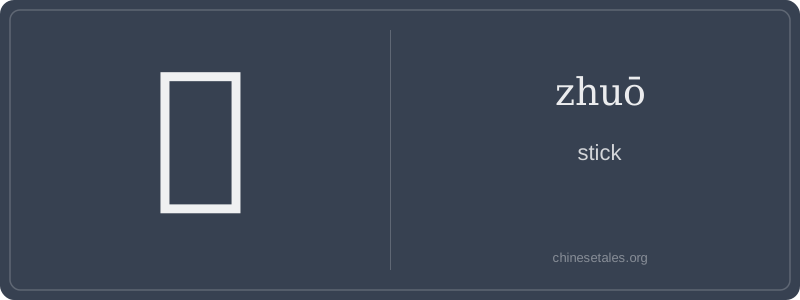
The earliest form of 棁 appears in bronze inscriptions (jinwén) as a simple vertical line (丨) with two short horizontal strokes near the top and bottom—depicting a smooth, tapered wooden rod held upright, perhaps standing beside a ritual cauldron. Over time, the top horizontal evolved into the ‘wood’ radical 木 (mù), anchoring its material identity, while the lower part solidified into 卓 (zhuó)—a phonetic component meaning 'lofty, outstanding', hinting at the rod’s elevated function in ceremony. The final form, 木 + 卓, visually declares: 'a wood object of distinction.'
In the *Rites of Zhou* (Zhōulǐ), 棁 refers specifically to the standard-length rod used by officials to verify measurements during land surveys and granary inspections—ensuring fairness through physical consistency. By the Han dynasty, it also named rods supporting ancestral tablets in temples. Its semantic path is remarkably stable: from concrete measuring tool → symbolic standard → abstract emblem of integrity. Unlike many characters that drifted into metaphor, 棁 stayed anchored to its physical essence—never becoming a verb or abstract noun. Its shape remains a literal echo: a tall, upright piece of wood, standing still across three millennia.
Imagine you’re in a dusty antique shop in Xi’an, and the shopkeeper pulls out a slender, carved wooden rod—smooth from centuries of handling—and says, 'Zhè shì yī gēn zhuō, used to stir herbal decoctions in the Ming dynasty.' That’s 棁: not just any stick, but a *ritual or functional rod*—long, straight, often ceremonial or medicinal. It carries quiet authority: not a weapon like 枪 (qiāng), not a casual twig like 枝 (zhī), but something deliberately shaped, held with purpose. In classical texts, 棁 appears as a measuring rod or a support for ritual vessels—always implying precision, stability, and subtle control.
Grammatically, 棁 is almost exclusively a noun and rarely appears in modern spoken Mandarin—it’s literary, historical, or technical. You won’t hear it in HSK dialogues, but you might see it in museum labels ('青铜棁'—bronze measuring rod) or classical poetry describing ceremonial implements. Learners sometimes misread it as 琢 (zhuó, 'to polish') due to similar sound and visual weight, but 棁 has no verb usage—it never means 'to stick' or 'to poke'. It’s a static object, not an action.
Culturally, 棁 embodies the Confucian ideal of measured conduct: like a perfectly balanced rod, human behavior should be upright, calibrated, and unyielding in principle. Mistake it for 杵 (chǔ, 'pestle')? You’ll conjure images of pounding herbs—not stirring them. Its rarity makes it a 'linguistic fossil': when it appears, it signals antiquity, craftsmanship, or scholarly precision—not everyday utility.