梴
Character Story & Explanation
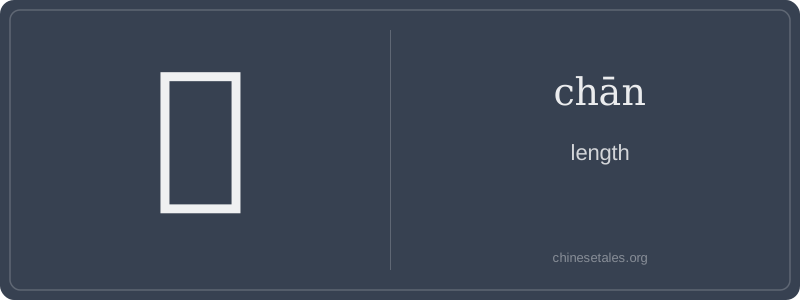
The earliest form of 梴 appears in Warring States bamboo slips (c. 475–221 BCE) as a compound: a left-side 木 (wood) radical paired with a right-side 占 — not the modern simplified 占, but an oracle bone-derived glyph showing a mouth (口) above a divination crack (卜), symbolizing authoritative pronouncement. Over centuries, 占’s strokes condensed: the upper mouth shrank into a dot and horizontal stroke, the lower crack smoothed into a vertical with a hook — giving us today’s 占. Meanwhile, 木 retained its classic four-stroke tree shape, anchoring the character in the material world of timber and construction.
This visual fusion wasn’t poetic — it was pragmatic. In ancient China, measuring length for architecture or land division wasn’t math; it was cosmology. A carpenter’s ruler carried ritual weight — aligning beams with celestial order required divine sanction (hence 占). The *Shuōwén Jiězì* (121 CE) defines 梴 as ‘the standard measure of wood’ — not just any length, but *the sanctioned length*. By the Ming dynasty, its use collapsed entirely; builders adopted 长 and 丈, while 梴 retreated into lexicographical limbo — a perfect rectangle of meaning, preserved only because scribes refused to let go of their standards.
Let’s be honest: 梴 (chān) is a ghost character — technically real, historically attested, but functionally extinct in modern Mandarin. Its core meaning ‘length’ isn’t abstract or philosophical like 长 (cháng); it’s tactile and architectural — think the precise span of a beam, the measured reach of a roof rafter, or the calibrated depth of a well. In classical texts, it appeared almost exclusively in technical descriptions of construction, cartography, or ritual geometry — never in poetry or daily speech. You won’t hear it in conversation, and no native speaker under 80 would recognize it without consulting a dictionary.
Grammatically, 梴 was always a noun or measure word, never a verb or adjective. Unlike 长 (which can mean ‘long’, ‘to grow’, or even ‘leader’), 梴 had zero derivational flexibility — no compounds, no reduplications, no aspect particles. It stood alone like a surveyor’s rod: rigid, exact, silent. Learners sometimes stumble upon it in Tang dynasty stele inscriptions or Song dynasty engineering manuals — and assume it’s a variant of 长. Big mistake! Using 梴 where 长 belongs reads like quoting Shakespeare using Old English ‘þæt’ instead of ‘that’: archaic, jarring, and instantly flagged as unnatural.
Culturally, 梴 reveals how Chinese thought once encoded precision *in the character itself*: its structure literally combines ‘wood’ (木) with ‘divination/standard’ (占), implying measurement rooted in ritual authority and material craft. Modern speakers value brevity and versatility — so this hyper-specialized, unadaptable character faded, surviving only in dictionaries as a fossil of pre-Imperial technical literacy.