梏
Character Story & Explanation
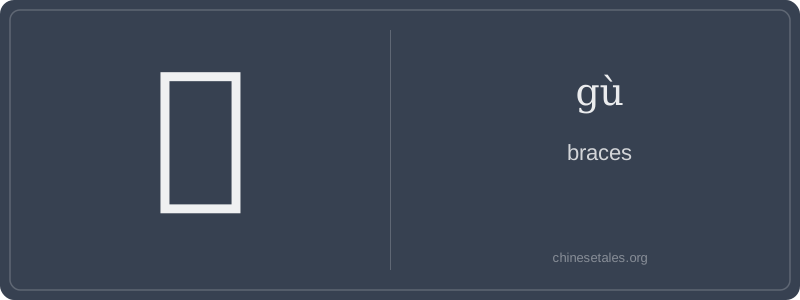
The earliest form of 梏 appears in Warring States bamboo slips — not as a pictograph, but as a clear compound: left side 木 (wood), right side 固 (gù, 'solid, firm'). It wasn’t drawn as shackles; it was *constructed* as a conceptual blend: 'wood + solidity = something wooden that makes things immovably solid'. Over time, the right-hand component simplified from full 固 (12 strokes) to its modern 7-stroke form — losing the 'mouth' (口) at the top but keeping the 'enclosure' (囗) and 'earth' (土) beneath, preserving the idea of 'sealed-in firmness'. The 11 strokes we write today encode this logic: 4 for 木, 7 for the condensed 固.
This character never described gentle support — it always implied coercion. In the Book of Rites (Lǐjì), 梏 appears in descriptions of judicial procedure: 'those accused of grave crimes were 梏 at the ankles before interrogation'. By the Ming dynasty, medical manuals used it precisely for rigid orthopedic devices — not flexible bandages, but stiff wooden frames lashed to limbs. The visual duality is striking: the soft, living 木 radical literally *holds* the rigid, enclosing 固 — like wood enforcing immobility. That tension — organic material used for control — is baked into every stroke.
At first glance, 梏 (gù) feels like a quiet, dusty character — and that’s fitting, because it’s nearly extinct in modern spoken Chinese. Its core meaning is 'wooden restraints' or 'braces', specifically rigid, inflexible ones made of wood: think ancient handcuffs, splints for broken limbs, or even structural braces holding up a collapsing beam. The 'wood' radical (木) isn’t decorative — it’s essential. This character doesn’t mean abstract constraint (that’s 束 or 限); it means physical, tangible, *wooden* confinement — heavy, unyielding, and slightly archaic.
Grammatically, 梏 functions almost exclusively as a noun or verb in formal/literary contexts — you’ll rarely hear it in daily chat. As a verb, it’s transitive and often appears in classical or legal phrasing: 'to shackle with wooden cuffs'. Learners sometimes misread it as a synonym for 固 (gù, 'firm') or 顾 (gù, 'to attend to'), but those are false friends: 梏 carries no positive connotation — it’s inherently restrictive, even punitive. You won’t say 'I 梏 my resolve'; you *do* say 'the prisoner was 梏ed before trial' (in historical texts).
Culturally, 梏 evokes imperial justice — the clack of wooden shackles in Tang dynasty court records, or medical texts from the Song dynasty prescribing 'wooden 梏' to immobilize fractures. Modern usage is almost entirely literary or juridical: appearing in idioms like 梏手梏足 (gù shǒu gù zú, 'shackled hands and feet'), or in historical novels describing punishment. A common learner mistake is overgeneralizing it to any 'constraint' — but if you use 梏 where 固 would fit, your sentence suddenly sounds like someone’s being arrested instead of just being stubborn!