梍
Character Story & Explanation
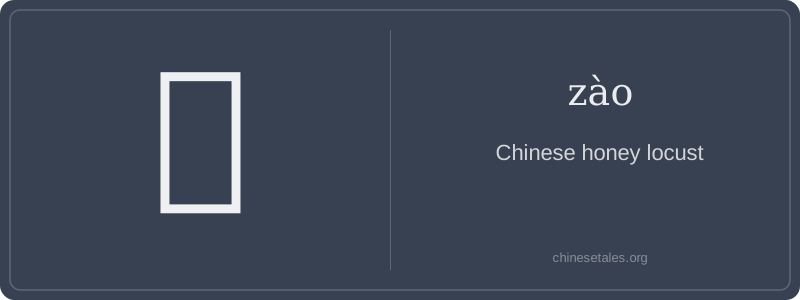
The earliest form of 梍 appears in Han-dynasty seal script, not oracle bones — it’s a relatively late addition to the character system, reflecting the growing need for precise botanical terminology. Visually, it’s a semantic-phonetic compound: the left radical 木 (mù, ‘tree’) anchors its meaning, while the right component 皂 (zào, ‘black/dark soap’) serves phonetically — though 皂 itself evolved from a pictograph of a hand holding a dark-stained cloth, symbolizing cleansing. Over centuries, the 皂 side simplified from complex bronze forms to today’s clean, angular strokes: the top ‘white’ component (白) fused with the lower ‘ten’ (十) and ‘dipper’ (丶+丨) shape, yielding the modern 皂.
Meaning-wise, 梄 emerged during the Tang–Song transition, when scholars began systematically classifying native flora. Its association with 皂 wasn’t arbitrary: honey locust pods contain saponins — bitter, foaming compounds used since antiquity as natural soap and medicine. In Li Shizhen’s Bencao Gangmu (1596), 梄 appears under ‘wood category’ entries describing how its bark ‘cleanses wind-dampness’. The character’s visual duality — tree + ‘soap’ — thus encodes both ecology and utility: a living pharmacy rooted in wood.
Imagine walking through an ancient temple courtyard in Xi’an, where gnarled, thorny trees drip golden pods into stone basins — that’s the zào tree (Chinese honey locust), and 梍 is its name. This isn’t a poetic or abstract term: it’s a precise botanical noun, used almost exclusively in scientific, horticultural, or regional contexts — never in daily conversation or beginner textbooks. You’ll see it on plant labels at Beijing Botanical Garden, in forestry reports, or in classical herbal texts like the Bencao Gangmu, where its bark and pods were noted for medicinal use.
Grammatically, 梍 behaves like any concrete noun: it appears after measure words (e.g., yī kē zào shù — one tree), rarely takes aspect particles (-le, -guo), and almost never appears alone — it’s nearly always part of a compound like zàoshù (honey locust tree) or zàojiá (honey locust pod). Learners often mistakenly treat it as a verb (‘to ferment’ — confusing it with 酵) or misread it as cào (like 草), but its pronunciation is firmly zào, with the ‘z’ sound of ‘zoo’, not ‘ts’.
Culturally, 梍 evokes resilience: this drought-tolerant, nitrogen-fixing tree was historically planted along Silk Road oases and imperial roads for shade and soil stabilization. Its pods yield a natural saponin used in ancient laundry and ritual cleansing — linking it subtly to purity and utility. Don’t expect to hear it on HSK exams or subway announcements; but if you’re reading a Qing-dynasty agricultural manual or identifying native species in Shanxi, 梍 will be your quiet, thorny companion.