柯
Character Story & Explanation
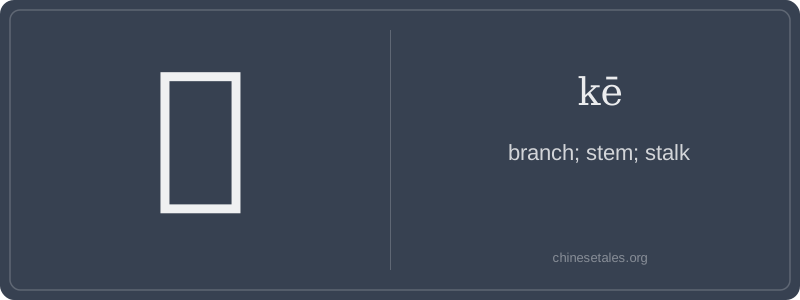
The earliest form of 柯 appears in bronze inscriptions as a pictograph combining 木 (tree) with 可 — but not the modern 可! In Shang-era script, 可 was a stylized depiction of a hand holding a tool (like an adze) carving into wood. So the original 柯 showed a carpenter shaping a strong branch — literally 'wood shaped for use.' Over centuries, the hand-and-tool element simplified into today’s 可 component, while the 木 radical remained firmly rooted on the left, anchoring the meaning in the botanical world.
This origin explains why 柯 always implies utility and resilience: it’s not just any branch, but one selected for building, crafting, or bearing weight. In the *Zuo Zhuan*, 柯 describes the stout limbs of sacrificial trees; by the Tang dynasty, poets used 柯干 metaphorically for ‘foundational virtue’ in a family line. Even today, its shape — 木 + 可 — whispers ‘wood that can (be relied upon)’: a subtle stroke-level pun on reliability baked into the character’s bones.
Think of 柯 (kē) as the 'structural engineer' of plant anatomy in Chinese — not the leafy green part you picture when you hear 'branch,' but the sturdy, load-bearing limb: a woody stem or main branch, like the thick arm of an oak tree that holds up the whole canopy. It’s more architectural than botanical, evoking strength and support — which is why it appears in surnames (e.g., 柯姓) and classical metaphors for lineage or authority, not casual garden talk.
Grammatically, 柯 is almost never used alone in modern speech; it’s a literary or compound-bound character. You won’t say *‘This is a kē’* — instead, it shows up in fixed terms like 柯条 (kē tiáo, 'sturdy branch') or poetic compounds like 柯干 (kē gān, 'main stem'). Learners often misread it as a general word for 'branch' (like 枝 zhī), but using 柯 where 枝 belongs sounds archaic or jarringly formal — like calling a coffee cup a 'chalice' at Starbucks.
Culturally, 柯 carries quiet prestige: its presence in surnames (one of China’s 100+ ancient clan names) and classical texts (e.g., the *Book of Rites*) ties it to ancestral continuity. A common mistake? Confusing it with the homophone 可 (kě, 'can/may') — same sound, zero semantic overlap. Also, don’t force it into colloquial contexts; it’s a character that prefers ink, poetry, and genealogy over WeChat messages.