柮
Character Story & Explanation
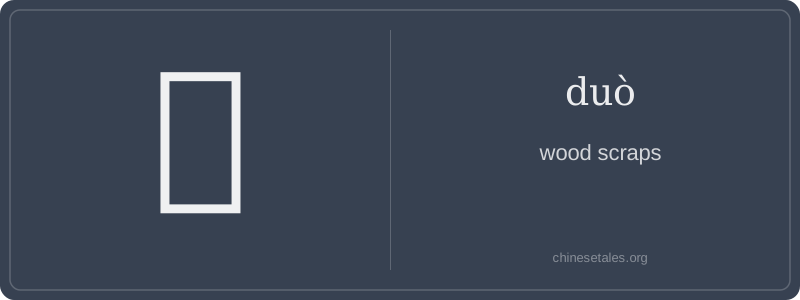
The earliest form of 柮 appears in late Warring States bamboo slips — not oracle bone, but close: a left-side 木 (mù, ‘tree/wood’) radical anchoring the character, and a right-side component that evolved from a simplified pictograph of *shattered fragments*: originally three jagged, angular strokes resembling broken wood fibers (⿱丷彡 → later stylized into 又 + 一 + 丿). Over centuries, clerical script smoothed the edges; the right side condensed into 又 (yòu, ‘again’), but here it functions purely phonetically — its shape no longer means ‘again’, though its sound (duò) echoes older pronunciations like *dak* in Middle Chinese.
This character’s semantic path is beautifully literal: it began as a concrete depiction of wood debris, and never drifted into metaphor or abstraction. Unlike characters that acquired philosophical weight (e.g., 道 dào), 柮 stayed grounded — literally. In the 11th-century *Guangyun* rhyme dictionary, it’s defined tersely as ‘cut-off wood pieces’ (斫木殘也), and in Ming dynasty carpentry scrolls, it labels waste piles next to diagrams of joinery. Its visual stability — unchanged for 2,300 years — mirrors its meaning: scrap doesn’t evolve. It just accumulates.
Let’s get real: 柮 (duò) is a quiet relic — not flashy, not frequent, but deeply tactile. It doesn’t mean ‘wood’ in the abstract sense like 木 (mù), nor does it evoke forests or furniture. It means *wood scraps*: splinters, shavings, offcuts — the gritty, fibrous debris left behind after sawing, carving, or splitting timber. Think of the dusty pile beneath a carpenter’s bench, or the curled ribbons of wood clinging to a chisel. That’s 柮 — humble, unrefined, and emphatically *waste material*. Its feel is coarse, slightly chaotic, and very physical.
Grammatically, 柮 is almost always a noun and rarely stands alone. You’ll find it embedded in compound nouns (e.g., 木柮, 柮屑) or modified by measure words like 些 (xiē) or 堆 (duī). It never takes aspect markers (了, 过) or verbs — you won’t say ‘I 柮-ed the plank’. Instead, it appears in descriptive or inventory contexts: ‘a pile of wood scraps’, ‘sweeping up the 柮’. Learners sometimes mistakenly use it as a verb or confuse it with general ‘wood’ — a subtle but meaningful error: saying 柮 instead of 木 turns ‘the wooden table’ into ‘the table made of wood shavings’ (which sounds like a very fragile piece of furniture).
Culturally, 柮 carries a quiet echo of pre-industrial craftsmanship — it’s the residue of human labor on raw material. You’ll encounter it in classical texts describing timber processing (e.g., in Song-era forestry manuals) or in modern dialectal usage in woodworking communities in Fujian and Zhejiang. It’s absent from HSK because it’s hyper-specific — but mastering it reveals how Chinese encodes materiality with astonishing precision: not just ‘wood’, but *what kind* of wood, and *in what state*.