柩
Character Story & Explanation
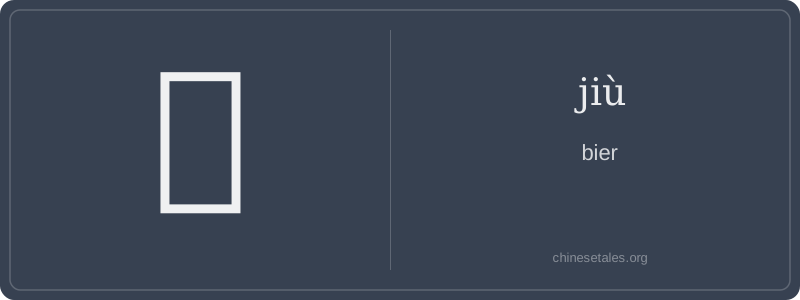
The earliest form of 柩 appears in Warring States bamboo slips as a pictograph showing a horizontal wooden frame (the 木 radical) supporting two parallel bars — representing the crossbeams of a ceremonial bier. Over centuries, the top evolved into the 'old person' component (舊, simplified here to 就's upper part), hinting at antiquity and ritual continuity; the bottom retained 木 (wood), emphasizing materiality. By Han dynasty seal script, the shape stabilized: the left side became 木 (tree/wood), and the right condensed from 舊 (jiù, 'old') — not for age, but as a phonetic loan, capturing the sound while preserving the wood-based function.
This character appears in the Rites of Zhou and Mencius’ writings, where '奉柩' (fèng jiù) meant 'to reverently escort the bier' — a duty tied to filial piety. Its visual logic is elegant: wood (木) + sound/meaning anchor (就, implying 'arrival' or 'settling') = the structure on which the deceased 'arrives' at rest. Unlike plain coffins, the bier was carried in procession — so 柩 subtly conveys motion, respect, and ritual journey, not static containment.
Think of 柩 (jiù) not as a generic 'coffin' but as a sacred, ritual object — the bier: the wooden platform that carries the body during funeral processions. It’s deeply rooted in Confucian mourning rites, where the physical vessel matters profoundly: it’s not just *what* holds the deceased, but *how* — with dignity, stability, and ancestral reverence. The character feels solemn, weighty, and intentionally formal; you’ll almost never hear it in casual speech or modern news — it belongs to classical texts, temple inscriptions, or solemn ceremonial contexts.
Grammatically, 柩 is a noun that rarely takes modifiers directly — you won’t say 'big 柩' or 'red 柩'. Instead, it appears in fixed compounds (like 棺柩) or after honorifics ('灵柩', '遗柩') and often follows verbs like 迎 (to welcome), 奉 (to respectfully carry), or 安放 (to place). A common learner mistake is using 柩 alone as if it were 'coffin' — but native speakers nearly always pair it: saying just 柩 sounds stark, even jarring, like referring to a 'bier' without context in English.
Culturally, 柩 evokes the ancient belief that the body must remain intact and respectfully elevated until burial — hence the bier’s raised structure, symbolizing transition between worlds. Mispronouncing jiù as jiū (a common slip) risks confusion with 久 (long time) or 酒 (alcohol) — both wildly inappropriate in funerary contexts! And crucially: while 棺 means 'coffin' (the box), 柩 is the *platform* — they’re complementary, not interchangeable.