柁
Character Story & Explanation
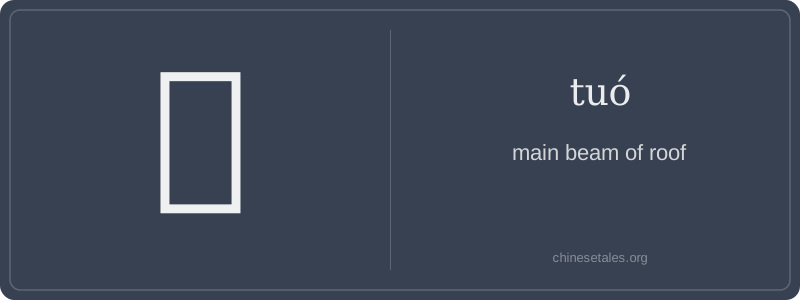
The earliest form of 柁 appears in Han dynasty seal script, not oracle bones — it’s relatively late in the character evolution timeline. Visually, it’s a clear compound: the left side is 木 (mù), the 'tree/wood' radical, anchoring it firmly in the realm of timber. The right side is 它 (tā), which originally depicted a serpent (in oracle bone script) but by the Warring States period had become a phonetic component — chosen here for its sound (tuó/tā) rather than its meaning. Stroke by stroke, the modern form stabilizes into nine clean strokes: four for 木 (horizontal, vertical, dot,捺), then five for 它 (dot, horizontal, vertical, bent hook, final dot-like stroke). No pictographic flourish — this is functional orthography born from phonetic borrowing.
Meaning-wise, 柁 emerged during the Han–Tang transition as vernacular building terminology crystallized in written records. Unlike poetic or philosophical characters, 柁 was forged in workshops — mentioned in Tang dynasty carpentry notes and Song dynasty architectural treatises like the *Yingzao Fashi*. Its visual simplicity (just wood + sound) belies its structural importance: in classical architecture, the 柁 literally bears the weight of the heavens — supporting the roof that shelters ritual, family, and state. Interestingly, the character never acquired metaphorical extensions (unlike 梁, which can mean 'pillar of society'); 柁 stays stubbornly literal, a testament to the precision demanded by master builders.
Let’s crack 柁 (tuó) open like a carpenter examining a roof beam — because that’s exactly what it is: the central, load-bearing horizontal timber across the top of a traditional Chinese wooden roof frame. It’s not just any beam — it’s the *main* one, the backbone that holds up the rafters and transfers weight to the pillars. Think of it as the spine of the roof. This character carries architectural gravity: it’s technical, precise, and deeply rooted in classical construction vocabulary — so you’ll mostly encounter it in historical texts, architecture manuals, or restoration projects, not casual conversation.
Grammatically, 柁 functions exclusively as a noun — no verbs, no adjectives, no derivations. It doesn’t take aspect particles like 了 or 过, nor does it combine freely with common modifiers like 很 or 非常. You’ll see it after measure words like 一根 (yī gēn — 'a piece of') or in compound terms like 柁梁 (tuó liáng). A classic pattern is [structure] + 的 + 柁 — e.g., ‘这座古庙的柁’ (zhè zuò gǔ miào de tuó), meaning 'the main beam of this ancient temple.' Learners sometimes wrongly treat it as a verb ('to support') or overgeneralize it to mean 'any beam' — but that’s where 梁 (liáng) or 檩 (lǐn) step in, each with their own structural role.
Culturally, 柁 reflects how intimately Chinese language maps onto craftsmanship: every timber has its name, its place, its purpose. Mistaking 柁 for 梁 is like calling the keel of a ship the mast — technically wrong and architecturally embarrassing. And yes, this character is absent from the HSK list precisely because it’s specialized: it’s the kind of word you learn when you’re reading about Forbidden City restoration, not ordering dumplings. Its rarity makes it a quiet badge of linguistic depth — if you know 柁, you’ve peeked behind the roof tiles.