枻
Character Story & Explanation
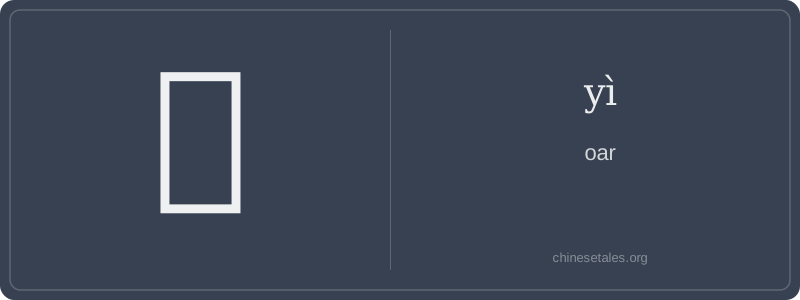
The earliest form of 枻 appears in Warring States bamboo slips and small-seal script — not as a pictograph of an oar itself, but as a highly stylized composite: the left side (木) clearly marks 'wood', while the right side (曳) originally depicted a hand pulling a long object (like a rope or pole) across ground — later abstracted into 曳 (yè), meaning 'to drag' or 'to pull'. Over centuries, 曳 simplified and fused with 木, losing its hand element but retaining the sense of *controlled, flowing motion* — perfectly capturing how an oar doesn’t just push water, but *draws* the boat forward with grace.
This visual logic anchored its meaning: by the Han dynasty, 枻 was standard for the slender, tapered oar used in southern China’s narrow canals and poetic junks. It appears in Qu Yuan’s 'Li Sao' ('Encountering Sorrow'), where '叩枻而歌' (kòu yì ér gē, 'knocking the oar and singing') symbolizes the upright scholar refusing corruption — the oar becomes both tool and moral compass. Even today, when writers want to evoke timeless, unhurried travel, they reach for 枻 — not because it’s practical, but because its strokes *still pull*.
Think of 枻 (yì) not as just 'oar' but as the *poetic soul* of rowing — it’s the elegant, slender oar that glides through water in classical poetry, not the clunky paddle you’d use on a modern kayak. In Chinese, it carries a quiet dignity: it’s almost never used in spoken Mandarin today (hence its absence from HSK), but it lives vividly in literary texts, historical descriptions, and compound words like 棹枻 (zhào yì), where it pairs with 棹 (another word for oar) to evoke rhythmic, meditative boating — think Tao Yuanming drifting down a misty river.
Grammatically, 枻 functions almost exclusively as a noun, usually appearing in fixed literary compounds or parallel constructions. You won’t say 'I hold the 枻' — instead, it appears in phrases like '操枻而歌' (cāo yì ér gē, 'to grasp the oar and sing'), where it’s part of a rhythmic, four-character idiom. Learners often misread it as yǐ (like 已) or confuse it with 易 (yì, 'easy') — both sound identical but carry wildly different meanings and tones.
Culturally, 枻 is a subtle marker of refinement: using it signals literary awareness, much like dropping 'thou' or 'hath' in English poetry. Its rarity makes it a delightful 'Easter egg' — spot it in a Tang poem or Song essay, and you’ve just glimpsed a vanished world of scholar-boaters, bamboo rafts, and ink-washed rivers. Mistake it for 易 or 翊? You’ll accidentally swap 'oar' for 'easy' or 'to assist' — a poetic disaster!