枲
Character Story & Explanation
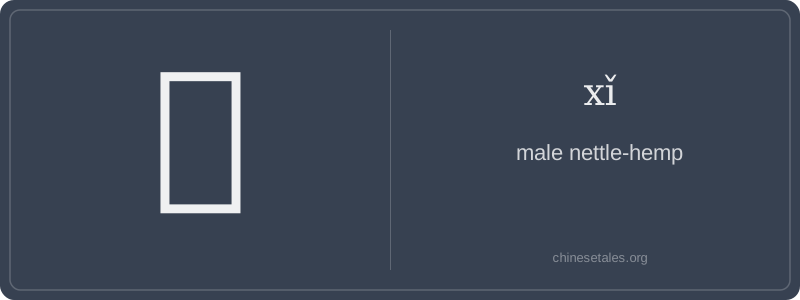
The earliest form of 枲 appears in bronze inscriptions (c. 1000 BCE) as a stylized cluster of three interwoven vertical strokes (like |||) beneath a roof-like canopy (宀), symbolizing cultivated hemp stalks growing under shelter or storage—possibly indicating harvested fiber bundles kept dry. Over centuries, the ‘roof’ simplified into the top component (亠), while the three verticals evolved into the lower part resembling 台 (tái), though unrelated phonetically. By the seal script era, the shape stabilized into today’s 枲: 亠 + 台, with the ‘three lines’ now abstracted into the three horizontal strokes inside 台—still echoing bundled stalks, but now fully logographic, not pictorial.
This visual evolution mirrors its semantic journey: from a concrete image of stored hemp stalks to a precise taxonomic label for male plants. In the Shuōwén Jiězì (121 CE), Xu Shen defines it as ‘male hemp, whose fiber is coarse and long’, confirming its role in distinguishing reproductive morphology—a rare linguistic precision in pre-scientific botany. Later, in Tang dynasty herbal commentaries, 枲 appears alongside diagrams showing stem cross-sections, reinforcing how deeply its meaning was tied to observable plant anatomy—not just name, but identity.
Let’s start with the vibe: 枲 (xǐ) isn’t a character you’ll hear in daily chat—it’s a botanical fossil. It specifically means ‘male nettle-hemp’ (the fiber-y, non-seed-producing variety of Urtica cannabina or related plants), and it carries the quiet authority of classical Chinese botany. Think of it as the ‘male’ counterpart to 苴 (jū), which denotes the female, seed-bearing hemp plant—both are ancient, precise terms used in texts like the Rites of Zhou and Shuōwén Jiězì. You won’t see 枲 in modern news headlines or WeChat chats; it lives in dictionaries, agricultural classics, and scholarly reconstructions of ancient textile production.
Grammatically, 枲 functions almost exclusively as a noun—never a verb or adjective—and rarely appears alone. It’s almost always embedded in compounds (like 枲麻 or 枲皮) or paired with its female counterpart (e.g., 枲苴). Learners sometimes mistakenly treat it like a generic ‘hemp’ word (confusing it with 麻, má), but that’s like calling ‘oak’ and ‘maple’ both just ‘tree’. Using 枲 without context sounds archaic or overly technical—even native speakers might pause and ask, ‘Which specific nettle-hemp?’
Culturally, 枲 reveals how meticulously early Chinese agronomy classified plants by sex and function: male plants were valued for long, strong bast fibers (for rope, cloth, bowstrings); females for seeds (nutritious oil source) and resin. A common learner trap? Assuming 枲 is interchangeable with 大麻 (dàmá, ‘cannabis’) — nope! 枲 is non-psychoactive, ecologically distinct, and historically revered for utility, not intoxication. Its silence in modern speech isn’t obscurity—it’s specialization preserved like a specimen under glass.