枰
Character Story & Explanation
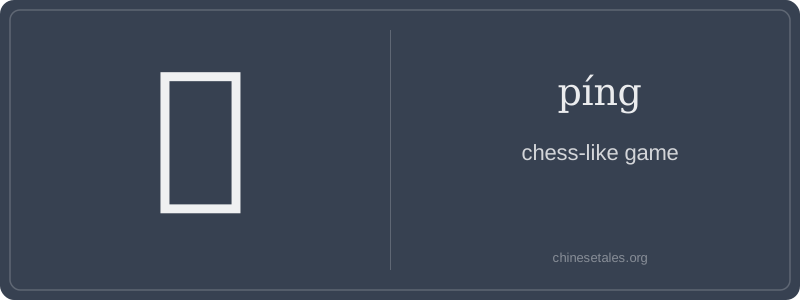
The earliest form of 枰 appears in seal script, not oracle bone, and already shows its essence: the left side 木 (mù, ‘tree/wood’) anchors the character visually and semantically, while the right side 平 (píng, ‘level, flat’) was originally a pictograph of a scale pan balanced evenly — two equal weights suspended over a central pivot. Over time, the scale evolved into the simplified 平 we know today. Crucially, every stroke reinforces function: the horizontal lines in 平 echo the board’s smooth surface; the vertical wood radical signals its traditional material — fine lacquered hardwood, prized for its resonance and grain.
By the Han dynasty, 枰 was firmly established in texts like the *Book of Han* to denote the official board used in imperial examinations’ strategic-military sections. Tang poets like Du Fu used it metaphorically: ‘一局棋枰天地小’ (yī jú qípíng tiāndì xiǎo — ‘One game on the board makes heaven and earth seem small’), elevating the board to a cosmic arena. Its meaning never broadened to mean ‘any game’ — unlike 棋 — preserving its dignity as the silent, level ground where genius and patience are measured.
At its heart, 枰 (píng) isn’t just ‘chess-like game’ — it’s a poetic, almost reverent word for the *board itself* as a site of refined intellect and quiet contest. Think less ‘game’ and more ‘sacred slab’: in classical Chinese, it specifically meant the flat, polished wooden board used for Go (weiqi), Xiangqi, or even ancient liubo. It carries the hush of a scholar’s study, not the clatter of a café chess set. You’ll almost never hear it in casual speech — no one says ‘Let’s play 枰!’ — because it’s inherently literary and formal.
Grammatically, 枰 is nearly always a noun and rarely stands alone. It appears in compound nouns (like 棋枰 qípíng, ‘Go board’) or in elegant phrases like ‘枰上风云’ (píng shàng fēngyún, ‘winds and clouds on the board’) — a metaphor for dramatic shifts in strategy. Learners sometimes mistakenly use it as a verb (‘to play chess’) or confuse it with 棋 (qí), but 枰 *never* means the act of playing — only the physical or symbolic surface where intellect meets restraint.
Culturally, 枰 reveals how deeply Chinese tradition links material objects with moral resonance: a well-crafted wooden board isn’t furniture — it’s a microcosm of order, balance, and silent dialogue. Modern learners often skip it entirely (it’s absent from HSK), yet encountering it in poetry or historical novels unlocks layers of classical sensibility. The biggest pitfall? Assuming it’s interchangeable with 棋. Remember: 棋 = the game; 枰 = the stage — and you wouldn’t call a theater ‘Hamlet’.